A live-cell autophagy reporter reveals reversible vacuolation in naked mole-rat skin fibroblasts under lysosomal stress

A live-cell autophagy reporter reveals reversible vacuolation in naked mole-rat skin fibroblasts under lysosomal stress
Tong, F.; Hoare, M. P.; Grundy, L. J.; Gallo, F.; Müller, K.; Smith, E. S. J.; Kumita, J. R.
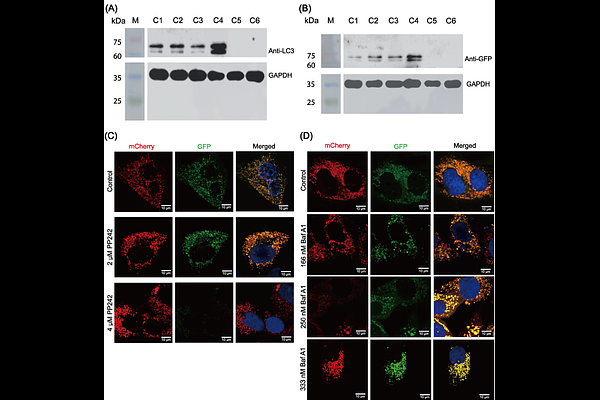
AbstractNaked mole-rats (NMRs, Heterocephalus glaber) display unusual longevity and resistance to age-related decline, and accumulating evidence suggests that their autophagy-lysosome pathway (ALP) is regulated differently from that of conventional mammalian models. However, most studies in NMR cells have relied on static biochemical or ultrastructural readouts, leaving the dynamic organisation of autophagy in living cells poorly defined. Here, we establish a stable tandem fluorescent autophagy reporter in NMR skin fibroblasts using an mCherry-EGFP-LC3-NMR construct to enable live-cell, single-cell resolution analysis of ALP dynamics. Under basal conditions, NMR skin fibroblasts exhibit a greater abundance of LC3-positive structures than HeLa cells, together with a mixed population of autophagosomes and autolysosomes, indicating a distinct steady-state organisation of the ALP. Chloroquine (CQ)-induced lysosomal stress caused the expected accumulation of LC3-positive structures but also triggered the formation of large cytoplasmic vacuoles in NMR skin fibroblasts. Importantly, this vacuolation was not associated with acute cytotoxicity and progressively resolved following CQ removal, accompanied by reorganisation of LC3-positive compartments and recovery of lysosomal acidity. Electron microscopy showed that CQ-induced vacuoles are membrane-bound, containing internal material and co-existing with multiple ALP-related vesicular compartments. Primary NMR skin fibroblasts display a similar vacuolation phenotype, indicating that this response is not an artefact of immortalisation or reporter expression. Together, these findings establish a live-cell platform for analysing autophagy in NMR cells and identify a distinctive, reversible vacuolation response to lysosomal stress, consistent with dynamic remodelling of the lysosomal system within NMR skin fibroblasts.