Bacterial Community Structure and Diversity of Common Mosquito Species in Chengdu: Insights from PacBio Third-Generation

Bacterial Community Structure and Diversity of Common Mosquito Species in Chengdu: Insights from PacBio Third-Generation
Xing, Y.; Wenjia, T.; Wei, Z.; Zelin, L.; Rong, L.; Kai, X.; Shuangfeng, F.
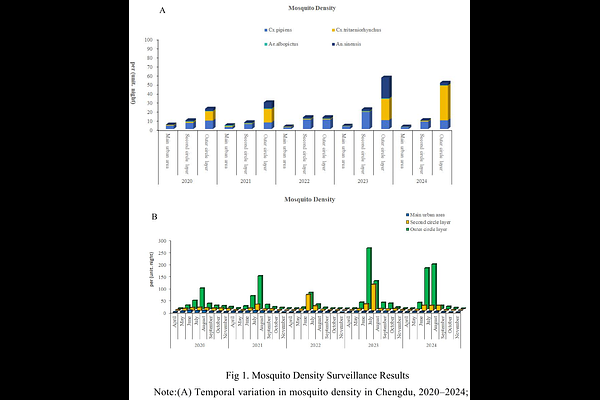
AbstractMosquitoes, as critical vectors of diseases such as Japanese encephalitis, dengue fever, and yellow fever, pose significant public health risks in Chengdu, a subtropical city in southwestern China. This study integrated ecological surveillance and PacBio third-generation sequencing to characterize the symbiotic microbiota of four dominant mosquito species (Aedes albopictus, Culex pipiens, Culex tritaeniorhynchus, and Armigeres subalbatus) across urban and rural habitats. From 2020 to 2024, mosquito density monitoring revealed spatial heterogeneity(Aedes albopictus, Culex pipiens, Culex tritaeniorhynchus, and Anopheles sinensis), with outer ring areas exhibiting the highest density (34.69 mosquitoes per trap), while central urban zones had the lowest (3.60). Sequencing identified 717 high-quality Amplicon Sequence Variants (ASVs), with Aedes albopictus harboring the most unique bacterial species (191). Beta diversity analysis demonstrated distinct microbial clustering among species, driven by Pseudomonadota dominance (54.27-93.89%) and variations in secondary phyla (Bacteroidota, Campylobacterota). Functional prediction via KEGG highlighted elevated human disease-associated pathways in Ae. albopictus, contrasting with reduced environmental adaptation activity. Notably, Wolbachia (clade B) and Klebsiella variicola exhibited species-specific abundance patterns, underscoring their roles in pathogen suppression and public health risks. Unclassified taxa (norank_d__Bacteria, Candidatus_Hydrogenedentes) clustered near novel mosquito-associated spirochetes, suggesting underexplored functional microbiota. This study provides foundational data for understanding mosquito-microbe interactions and informs strategies for mitigating vector-borne disease.