The Balancing Act: Olive baboon (Papio anubis) occupancy is associated with resource-related environmental variables rather than relative abundance of predators.

The Balancing Act: Olive baboon (Papio anubis) occupancy is associated with resource-related environmental variables rather than relative abundance of predators.
van Rooyen, N. T.; Prugnolle, F.; Rougeron, V.; Hofmeester, T. R.
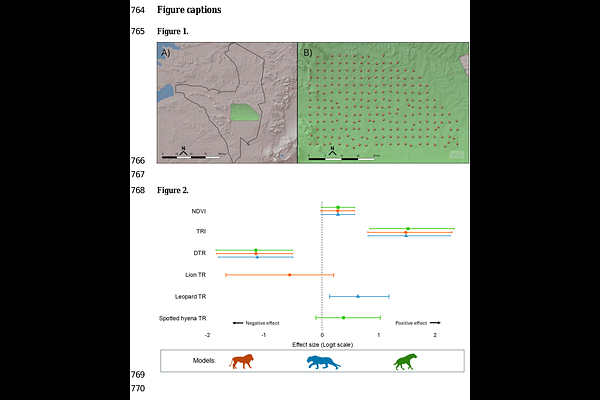
AbstractUnderstanding how the fear of predation acts as a driver of spatial distribution is fundamental to animal behaviour research, yet this relationship is not wholly understood in primates such as baboons. Olive baboons (Papio anubis) have evolved a diverse range of antipredator strategies that reduce, but do not eliminate, predation risk from the large carnivores they encounter across their broad geographic range. This raises a critical question: does the need to access essential resources outweigh the risk of predation when determining habitat selection? We addressed this question by examining the relative influence of three environmental factors and relative predator abundance on olive baboon occupancy patterns and detection probability in Serengeti National Park, Tanzania. Using data from 225 camera traps deployed by the Snapshot Safari program, we fitted three separate Bayesian occupancy models, each incorporating the same three environmental covariates (terrain ruggedness index, distance to nearest river, and Normalized Difference Vegetation Index, NDVI), together with the relative abundance of one of three principal predators (lion, leopard, or spotted hyena). This approach allowed us to assess whether environmental covariates associated with baboon occupancy remained consistent across different predator contexts. Baboon occupancy strongly increased with terrain ruggedness in all three models and consistently decreased with a greater distance to rivers. Vegetation greenness (NDVI) showed a positive association with baboon occupancy, though credible intervals narrowly overlapped zero. NDVI also showed a strong positive relationship with baboon detection probability. Associations between predator relative abundance and baboon occupancy varied between models: the relative abundance of lions and spotted hyenas showed no strong association with baboon occupancy, whereas the relative abundance of leopards was strongly correlated with baboon occupancy, consistent with shared habitat preferences. Our findings demonstrate that, independent of predator presence, olive baboon spatial distribution in the Serengeti is primarily and consistently associated with resource-related environmental features. This study expands our knowledge on the ecological factors that influence primate occupancy by showing that, for a behaviourally flexible species with diverse antipredator strategies, access to essential resources can outweigh spatial avoidance of predators in a multi-predator landscape.