Fluorinated RNA origami enables serum-stable nanodevices for sensing and targeting

Fluorinated RNA origami enables serum-stable nanodevices for sensing and targeting
Kristoffersen, E. L.; Zwergius, N. H.; Sampedro Vallina, N.; Stange, A. D.; Desdorf, L. M.; Thomsen, S.; Birkedal, V.; Glück, N.; Civit, L.; Geary, C.; Kjems, J.; Valero, J.; Andersen, E. S.
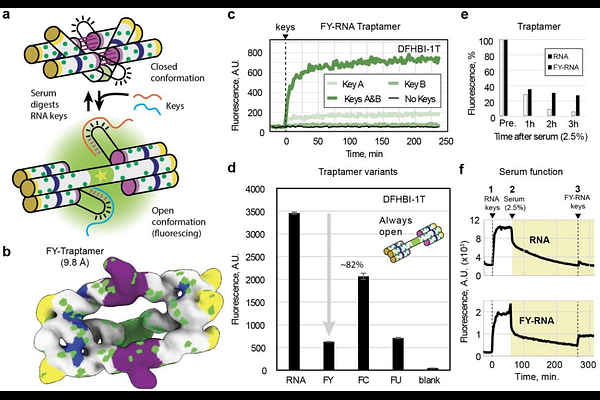
AbstractChemically modified RNAs with increased stability and reduced immunogenicity have transformed RNA therapeutics. Rational RNA design methods, including RNA origami, seek to further extend RNA medicine and biotechnology by encoding advanced functions such as signalling, targeting, and controlled release within the RNA polymer. However, current design methods lack the ability to integrate chemical modification or predict how it shapes the structure of large RNA assemblies inhibiting its use in RNA therapeutics. Here we demonstrate that 2'-fluoro pyrimidine RNA (FY-RNA) origami structures can be co-transcriptionally folded to generate serum-stable nanodevices. Cryogenic electron microscopy reveals that FY-RNA can alter folding pathways and perturb tertiary motifs, while molecular dynamics simulations show how 2'-fluoro modification affects hydrogen bonding, sugar pucker, and helix-helix interactions. Despite these structural perturbations, fluorogenic aptamers embedded within RNA origami retain partial activity and enable logic-based molecular sensing in human serum. Finally, we use an FY-RNA scaffold to determine the structure of an FY-RNA anti-Spike aptamer bound to the Spike protein at 3.4 [A] resolution, uncovering fluorine-specific structural motifs and protein interactions. Together, our results establish design principles for nuclease-resistant RNA architectures and position FY-RNA as a versatile polymer for constructing medical nanodevices and environmental sensors. More broadly, this work provides a framework for systematically exploring the folding landscape of chemically modified RNAs, expanding the chemical and functional diversity accessible to nucleic acid nanotechnology and RNA medicine.