Historic and contemporary museum specimens implicate Northern Red-backed Vole (Clethrionomys rutilus) as borealpox host as early as 1990s

Historic and contemporary museum specimens implicate Northern Red-backed Vole (Clethrionomys rutilus) as borealpox host as early as 1990s
Juman, M. M.; Doty, J. B.; Morgan, C. N.; Matheny, A.; Caudle, A.; Breslin, M.; Hamilton, N. M.; Gunderson, A.; Newell, K.; Rogers, J.; Balta, V. A.; Zecca, I. B.; Whitehill, F.; Minhaj, F. S.; McDonough, M. M.; Ferguson, A.; Li, Y.; Gigante, C.; Nakazawa, Y.; McLaughlin, J.; Olson, L. E.
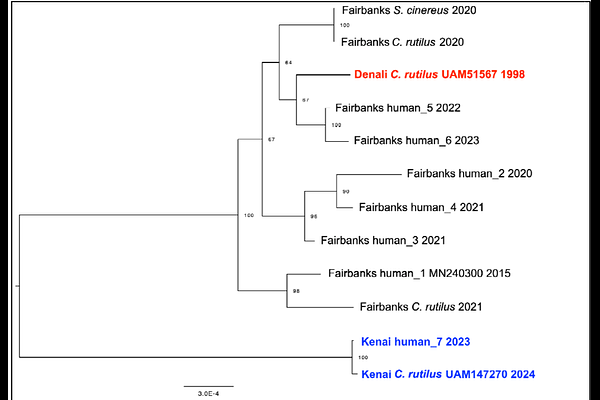
AbstractBorealpox virus (BRPV; formerly Alaskapox) is an orthopoxvirus that has caused seven reported human infections in Alaska since 2015, including a fatal case in 2023. The natural reservoir of BRPV is unknown, although previous investigations have raised the possibility of wild small mammals transmitting the virus to humans, either through direct contact or via domestic cats and dogs. To understand which species may be involved in the maintenance and/or spillover of BRPV in Alaska, we trapped and sampled wild small mammals (including voles, shrews, and squirrels) in 2021 and 2024 near reported human case locations in Fairbanks and the Kenai Peninsula, respectively. We found evidence of previous exposure to orthopoxviruses in five species (including the House Mouse, Mus musculus) and detected BRPV DNA as well as viable virus in Northern Red-backed Voles (Clethrionomys rutilus). Further, screening of tissues from historical museum specimens revealed BRPV DNA in C. rutilus specimens collected in Denali National Park and Preserve in 1998 and 1999, 17 years before the first reported human case of BRPV. Phylogenomic analysis of all human and animal BRPV isolates strongly supports the hypothesis of local human infections through multiple spillover events. These findings suggest C. rutilus as a possible reservoir species for BRPV and indicate that BRPV has been present in Alaskan wild small-mammal populations for at least 25 years. Our study highlights the potential of museum collections to elucidate the temporal, spatial, and host ranges of emerging pathogens. Further museum- and field-based sampling will clarify the true geographic range of BRPV, which is closely related to Old World orthopoxviruses and may be circulating beyond North America.