Impact of Kernel Dimensionality on the Generalizability and Efficiency of Convolutional Neural Networks to Decode Neural Drive from High-density Electromyography Signal

Impact of Kernel Dimensionality on the Generalizability and Efficiency of Convolutional Neural Networks to Decode Neural Drive from High-density Electromyography Signal
Fu, J.; Huang, H. J.; Wen, Y.
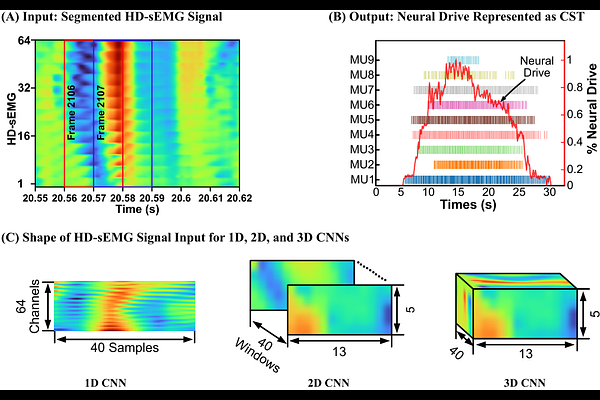
AbstractObjective: Convolutional neural networks (CNNs) have shown promise in decoding neural drive from high-density surface electromyography (HDsEMG) signals. However, the effects of convolutional kernel dimensionality on the generalizability and computational efficiency of CNN based neural drive decoding remain unclear. This study systematically examined how the dimensionality of convolutional kernels (1D, 2D, and 3D) affects both the generalizability and computational efficiency of CNN based neural drive decoding. Approach: Three CNN architectures differing only in the dimensionality of their convolutional kernels were implemented to extract temporal (1D), spatial (2D), or spatiotemporal (3D) features from HD sEMG signals of isometric knee extension, ankle plantarflexion at three intensities. Each CNN was repeatedly trained using subsets of a pooled training dataset with varying sizes. Cross intensity and cross muscle generalizability were assessed by the correlation coefficient between neural drive from deep CNN and that from golden standard blind source separation (BSS) algorithms. Computational efficiency was assessed by measuring inference time on both CPU and GPU platforms. Main Results: All CNN architectures demonstrated generalizability across contraction intensities and muscles. For cross contraction intensities, the 1D, 2D, and 3D CNNs achieved mean correlation coefficients of 0.986{+/-}0.009, 0.987{+/-}0.010, and 0.987{+/-}0.010, respectively. For cross-muscle generalizability, the corresponding correlation coefficients were 0.961{+/-}0.051, 0.965{+/-}0.049, and 0.968{+/-}0.046. In terms of efficiency, the 3D CNN was the least computationally efficient, with inference times of 4.1ms per sample on the CPU and 1.2ms per sample on the GPU. Significance: These findings demonstrate that increased CNN architectural complexity does not necessarily yield superior generalizability in neural drive decoding from HD sEMG signals. The results provide practical guidance for balancing decoding performance and computational efficiency in HD sEMG based neural machine interfaces.