Gene Flow Creates Fuzzy Species Boundaries in Fence Lizards

Gene Flow Creates Fuzzy Species Boundaries in Fence Lizards
Leache, A.; Davis, H.; Guerra, E.; Herrera, A.; Lemos-Espinal, J.; Fujita, M.; Myers, T. C.; Singhal, S.
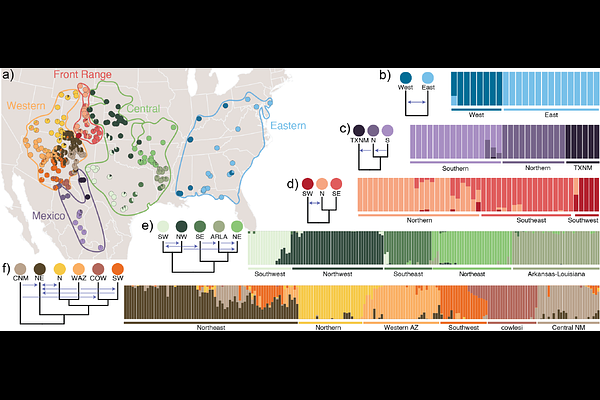
AbstractSpecies delimitation is a fundamental challenge in systematic biology, particularly for geographically variable taxa with hierarchical population structure and gene flow. Migration-aware coalescent models provide a powerful framework for investigating lineage divergence and accurately defining species boundaries. In this study, we combine statistical evaluations of gene flow with phylogenetic and population structure analyses to delimit species of fence lizards within the Sceloporus undulatus complex, a group characterized by extensive population subdivision, mitochondrial DNA introgression, and nuclear gene flow. We find that the undulatus complex exhibits uneven variation in genetic, morphological, and bioclimatic traits, resulting in variable distinctiveness among groups. In some cases, species boundaries are recognized by clear genetic discontinuities without gene flow. In others, shallow divergence, paraphyly, and gene flow produce leaky boundaries and fuzzy species limits. Mitochondrial introgression is extensive and concentrated at species boundaries, whereas nuclear gene flow occurs between only a few species and at much lower levels than within species. Neither within-species populations or species are substantially diverged across morphology or bioclimatic space, highlighting the limited utility of these traits for diagnosing species in this group. By integrating estimates of gene flow with phylogenetic and population structure analyses, this study provides a robust and biologically meaningful revised taxonomic framework for the undulatus complex that identifies independently evolving lineages as species.