Engineering Pseudomonas putida KT2440 for open-loop upcycling of mixed plastics

Engineering Pseudomonas putida KT2440 for open-loop upcycling of mixed plastics
Meng, H.; Karmainski, T.; Ammar, A. B.; Sieberichs, A.; Branson, Y.; Vossen, P.; Schwanemann, T.; Ballerstedt, H.; Bornscheuer, U. T.; Wei, R.; Blank, L. M.
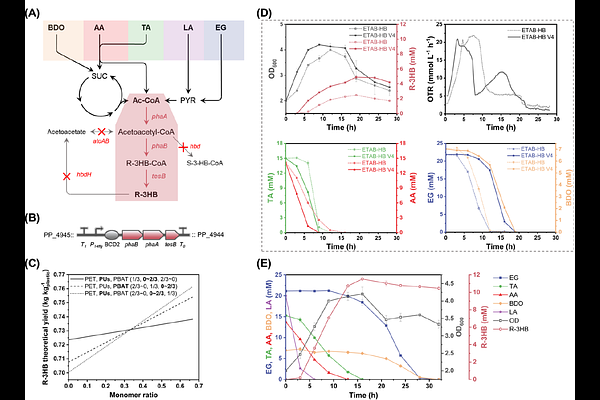
AbstractCurrent mechanical and chemical recycling strategies address less than 10% of global plastic waste, necessitating alternative valorization routes. Biological upcycling via enzymatic depolymerization combined with microbial conversion of the resulting monomers offers a promising pathway to transform mixed plastic waste into valuable alternatives. Here, we employed a single engineered Pseudomonas putida KT2440 for simultaneous co-utilization of five plastic monomers including ethylene glycol, terephthalic acid, adipic acid, 1,4-butanediol, and L-lactic acid, which can be derived from enzymatic hydrolysis of polyethylene terephthalate (PET), polybutylene adipate-co-terephthalate (PBAT), polyester-polyurethanes (PUs), and polylactic acid (PLA). Continuous fermentation over 21 days with alternating mixed-monomer feeds achieved steady state growth and complete substrate depletion, yielding adaptive mutations that informed iterative strain improvement. Further engineering enabled the biosynthesis of (R)-3-hydroxybutyrate (R-3HB), and 0.70 g/L R-3HB was produced directly from enzymatic hydrolysates of blended PET, PBAT, and TPU. These results establish a viable bio-based approach for upcycling realistic mixed plastics into value-added bioproducts.