Fast and Accurate Photon-Transport Modeling based on Foundation-Model-Encoded Implicit Neural Surrogate towards Optimized Near-Infrared Brain Stimulation

Fast and Accurate Photon-Transport Modeling based on Foundation-Model-Encoded Implicit Neural Surrogate towards Optimized Near-Infrared Brain Stimulation
Dong, S.; Guan, M.; Yang, L.; Liu, G.; Rominger, A.; Ren, W.; Ni, R.; Wei, X.
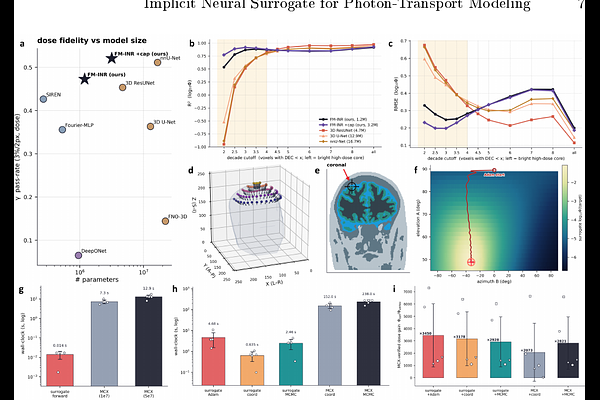
AbstractClinical treatment planning of near-infrared (NIR) brain stimulation requires patient-specific light dosimetry to optimize fluence delivery to cortical targets. The gold-standard Monte Carlo (MC) photon transport forward solver is accurate but computationally expensive and non-differentiable for personalized inverse design across subjects. Here, we present a foundation-model (FM)-encoded, differentiable implicit-neural surrogate for the MC solver. A pretrained 3D MRI/CT foundation model, VISTA3D, is domain-adapted to head phantoms with known optical properties to encode the subject anatomy. Next, an implicit neural representation is used to predict light fluence at arbitrary continuous coordinates. This formulation enables off-grid queries and gradients with respect to illumination parameters. Trained with a physics-informed, decade-stratified loss, the surrogate attains R2 {approx} 0.90 on held-out subjects. Ablation results show that the FM benefit is contingent on domain adaptation. Benchmarked against standard learned surrogates, our model is the most accurate in the high-dose region and best on dose-fidelity metrics ({gamma}-index, treated-volume DICE). Finally, gradient-based optimization through the surrogate recovers MC-consistent illumination configurations 50-240 x faster.