SNAP MRI Reveals Association Between Distal Cerebral Arterial Flow and Cognitive Function in an Aging Population

SNAP MRI Reveals Association Between Distal Cerebral Arterial Flow and Cognitive Function in an Aging Population
Ma, X.; Koppelmans, V.; Akcicek, H.; Akcicek, E. Y.; Shen, J.; Chen, L.; Balu, N.; Yuan, C.; King, J. B.
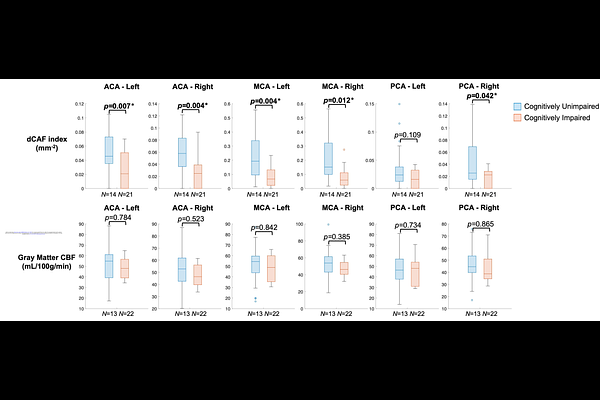
AbstractObjective: Impaired blood flow has recently been recognized as a critical contributor to cognitive impairment and dementia. It was reported that cerebral distal arterial flow measured from Simultaneous Non-contrast Angiography and Intraplaque Hemorrhage (SNAP) MRI is associated with post-treatment cognitive function improvement in carotid atherosclerosis patients. In this study, we aim to evaluate the value of SNAP-based measurements in assessing cerebrovascular function in an aging population. Materials and Methods: Neurovascular MRI data were collected on 36 aging participants (22 cognitively unimpaired and 14 impaired; 9 mild cognitive impairment (MCI) and 5 Alzheimer's Disease (AD)). Neurovascular MRI measurements, including white matter hyperintensities (WMH) volumes, cerebral blood flow (CBF), and SNAP-based distal cerebral arterial flow (dCAF) index, were quantified. Cognitive function was assessed using the Repeatable Battery for the Assessment of Neuropsychological Status (RBANS). Results: Significant differences in the dCAF index were observed between cognitively unimpaired and impaired groups, and the dCAF index was significantly correlated with the RBANS total score. While CBF was significantly associated with dCAF index, there is no significant correlation of CBF or WMH with the RBANS score in this population. Conclusion: Our findings suggest that the dCAF measured with SNAP MRI is valuable for evaluating the cognition-related cerebrovascular condition in an aging population.