Nox4 Mediates Diastolic Function in a Genetic Model of Pitx2 Haploinsufficiency

Nox4 Mediates Diastolic Function in a Genetic Model of Pitx2 Haploinsufficiency
Gardner, S.; Fatima, A.; Abusharkh, F.; Kobeck, E.; Basu, C.; Miller, F. J.; Agrawal, V.
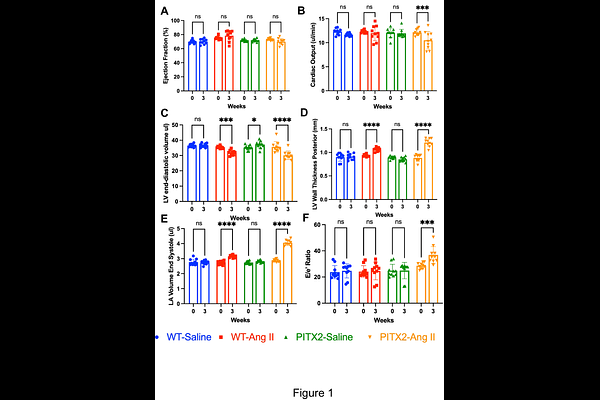
AbstractHeart failure with preserved ejection fraction (HFpEF) commonly coexists with atrial fibrillation (AF), but shared mechanisms remain unclear. In this study, we hypothesized that Pitx2, a transcription factor located near the strongest genetic locus associated with AF in humans, increases susceptibility to HFpEF-like remodeling. We also sought to understand pathways that might be central to this increased risk. Male and female Pitx2+/- mice and wild-type littermates received 3-week subcutaneous osmotic pump infusion of saline or angiotensin II (Ang II; 500 ng/kg/min). Cardiac structure and function were assessed by echocardiography and catheterization, and functional capacity by exercise treadmill. RNA transcriptomic profiling was performed to identify candidate pathways. In a separate cohort, Ang II-treated mice were randomized to oral GKT136901 (30 mg/kg/day) or vehicle during infusion. After Ang II infusion, Pitx2+/- mice developed exaggerated HFpEF-like changes, including greater left ventricular hypertrophy, left atrial enlargement, diastolic dysfunction, elevated left ventricular end-diastolic pressure, and reduced treadmill performance. RNA-seq showed enrichment of metabolic and stress-response pathways with selective upregulation of Nox4, confirmed by RT-qPCR. GKT136901 attenuated structural remodeling, diastolic dysfunction indices, elevated filling pressures, and cardiomyocyte hypertrophy, but did not improve endurance. These findings implicate redox signaling, including Nox4, in AF genetic susceptibility-HFpEF interactions.