Effects of management on global crop pest damage depends on coevolutionary indicators

Effects of management on global crop pest damage depends on coevolutionary indicators
Lai, H. R.; Tonkin, J. D.; Tylianakis, J. M.
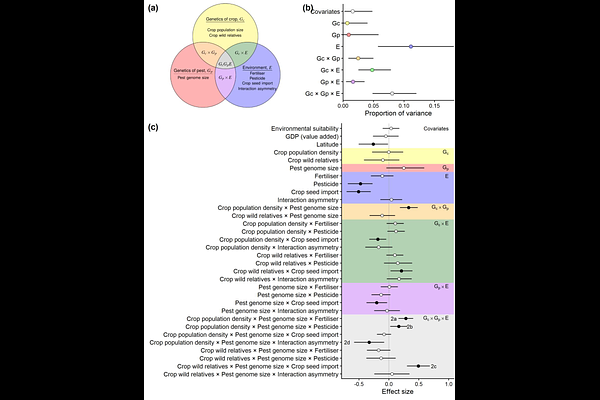
AbstractPests and pathogens reduce yields of major food crops by 15% globally. Interventions such as pesticides can mitigate yield loss, but pests can evolve resistance to pesticides over short timescales. Pest damage to crops may also be determined by (co)evolutionary selection on pests by crops themselves and vice versa, yet it is unclear whether the relative evolutionary potential of pests versus crops predicts the outcome of this arms race. Here we test whether readily available indicators of the evolutionary potential of crops and their pests or pathogens influence global yield loss and its response to agricultural management. We find that evolutionary potential of the pest (measured as its genome size) and crop (measured as population density or proximity of wild relatives) moderated the effect of agricultural management (seed importation, fertiliser and pesticide use) on crop damage. Crucially, statistical interactions among crop and pest evolutionary potentials explained as much variation in yield loss as did agricultural management. Our results show a huge spatial variability in management effectiveness and suggest greatest benefit in places with a stronger imbalance in the evolutionary potential between crop and pest. More broadly, our findings reveal a key role of evolution in determining present-day pest damage.