The cyanobacterium Anabaena uses pleomorphism as an acclimation strategy to high light stress

The cyanobacterium Anabaena uses pleomorphism as an acclimation strategy to high light stress
Velazquez-Suarez, C.; Mallen-Ponce, M. J.; Rubio, M. A.; Burnat, M.; Crespo, J. L.; Nürnberg, D. J.; Lopez-Igual, R.; Corrales-Guerrero, L.; Luque, I.
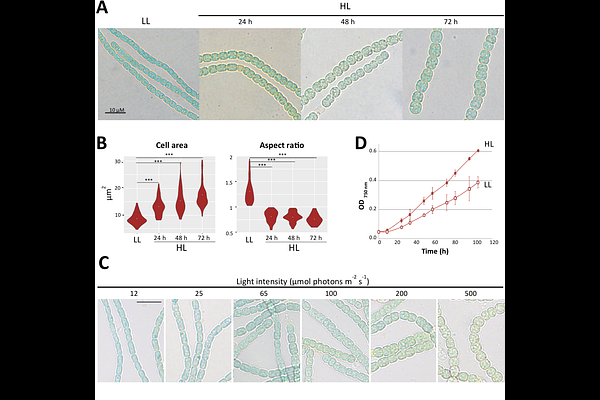
AbstractO_LIPhytoplankton species display characteristic morphologies that are generally assumed to confer adaptive advantages, yet the functional significance of cell shape remains poorly understood. Here, we investigated whether pleomorphism contributes to acclimation to changing light environments. C_LIO_LIUsing the cyanobacterium Anabaena sp. PCC 7120 as a model system, we combined molecular genetics, microscopy, physiological measurements and biophysical analyses to determine how morphology is regulated and how it affects photosynthetic performance under different light intensities. C_LIO_LIWe show that Anabaena undergoes a reversible light-dependent morphological transition from rod-shaped cells under low light to large globular cells under high light stress. This transition is controlled by the relative activities of the elongasome and class A penicillin-binding proteins and is accompanied by thylakoid reorganization. The globular morphology reduces light absorption and enables cells to maintain photosynthetic activity under photoinhibitory conditions. C_LIO_LIOur findings establish a mechanistic link between cell-wall remodelling, cellular optics and photosynthetic performance, revealing pleomorphism as a dynamic acclimation strategy to high light stress. More broadly, this work provides experimental support for the packaging effect and highlights morphology as an active determinant of phytoplankton fitness. C_LI