Fear Learning Induced Brain Dynamics Predict Individual Extinction Memory Expression following Transcranial Magnetic Stimulation

Fear Learning Induced Brain Dynamics Predict Individual Extinction Memory Expression following Transcranial Magnetic Stimulation
Zhang, K.; Cui, L.; Moallem, B. I.; Meelad, H.; Atiyah, Z.; Badarnee, M.; Isabella, M.; Wen, Z.; George, M.; Milad, M. R.
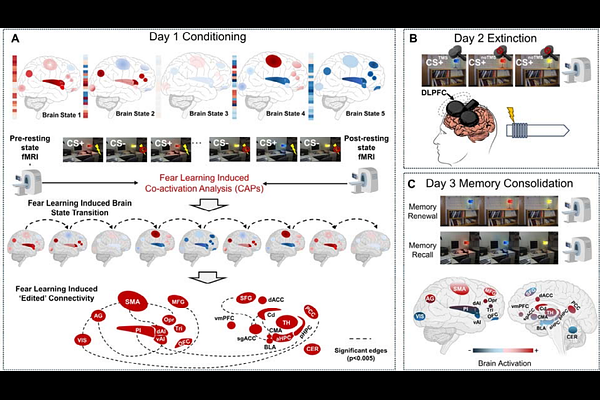
AbstractFear learning and extinction unfold as time-dependent processes. Herein, we examined how fear learning dynamically reorganizes brain activity immediately after learning, and whether such reorganization can be modulated with TMS application during extinction learning to prospectively predict extinction-memory expression. Eighty-seven healthy adults completed a three-day Pavlovian threat-learning protocol with resting-state fMRI acquired before and after conditioning (Day 1), dorsolateral prefrontal cortex (DLPFC) transcranial magnetic stimulation (TMS) applied during extinction learning (Day 2), and fMRI during extinction recall and renewal (Day 3). Using coactivation pattern analysis with a hidden Markov model within a 24-nodes threat-circuit parcellation, we identified a fear-learning induced brain state characterized by global threat-circuit coactivation with heightened engagement and transition uncertainty post conditioning, and a progressive increase in engagement across post-conditioning. Critically, conditioning-induced functional connectivity reorganization within this state predicted individual differences in extinction recall- and renewal-related brain activation under TMS-modulated extinction (cross-validated; recall r = 0.47, p = 0.001; renewal r = 0.37, p = 0.01; permutation-tested), but not under natural extinction. Similar associations were observed between neural features and behavioral expression. These findings demonstrate that fear learning reshapes spontaneous brain-state dynamics and that such learning-induced reorganization serves as an interpretable biomarker for neuromodulation-linked extinction-memory expression.