Tradeoffs in planning marine protected areas for kelp forest resilience: protecting climate refugia is not always the best solution

Tradeoffs in planning marine protected areas for kelp forest resilience: protecting climate refugia is not always the best solution
Hopf, J. K.; Giraldo-Ospina, A.; Caselle, J.; Kroeker, K.; Carr, M.; Hastings, A.; White, J. W.
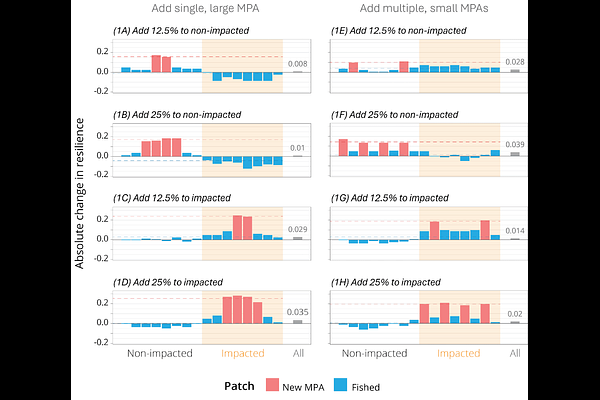
AbstractMarine protected areas (MPAs) are increasingly promoted as climate mitigation tools, yet guidance on their placement to maximize resilience against climate stressors like marine heatwaves remains limited. Here, we develop MPA placement guidelines that explicitly consider a mechanistic pathway through which MPAs could enhance kelp forest resilience to heatwaves: protecting fishery-targeted urchin predators to prevent kelp overgrazing. Using a spatially explicit, tri-trophic model of California kelp forests, we evaluate alternative MPA configurations across a hypothetical coastline where half the habitat experiences an increased probability of experiencing heatwaves. We found that effective MPA placement depends on whether MPAs are being newly established or reconfigured within an existing network, and that among-patch connectivity and spillover played vital roles in the relative effectiveness of different MPA configurations. Changes in resilience occurred primarily at the patch scale, with trade-offs between increased within-MPA resilience and decreased resilience in some fished areas, resulting in minimal coastwide population effects. For example, for new MPAs, large single MPAs within heatwave-prone areas maximized within-MPA resilience gains, while multiple small MPAs in heatwave refugia best supported whole-coast resilience. When reconfiguring established networks, expanding existing MPAs in refugia areas was most effective. We also demonstrate the importance of considering MPA recovery timescales: for example, relocating old MPAs to heatwave refugia yielded minimal short-term benefits due to the loss of rebuilt, previously fished, predator biomass. Our findings demonstrate that climate-adaptive marine planning should explicitly consider the spatiotemporal implications of trophic cascades, connectivity, and transient population dynamics to support ecosystem resilience.