Fusion-associated sexual development in a testate amoeba fills a major gap in the evolution of sex in Amoebozoa

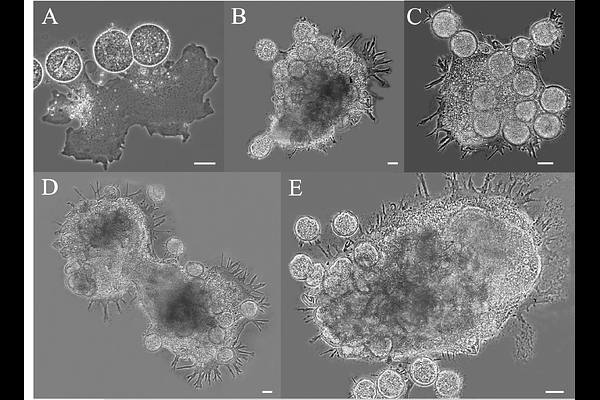
Fusion-associated sexual development in a testate amoeba fills a major gap in the evolution of sex in Amoebozoa
Tekle, Y. I.
AbstractSexual processes in microbial eukaryotes are often cryptic, obscuring the diversity and evolutionary history of sex across major eukaryotic lineages. Within Amoebozoa, trophic-cell fusion has been associated with sexual development in distantly related taxa, but evidence from Tubulinea, one of the three major amoebozoan lineages, has been lacking, leaving a major gap in the known distribution of fusion-associated sexual development. Here, we combine long-term behavioral observations with transcriptomic analyses to uncover an extensive fusion-associated developmental program in the testate amoeba Arcella vulgaris. Individual trophic cells progressively fused with neighboring amoebae to form large multinucleate aggregates exhibiting coordinated movement and cytoplasmic streaming. Transcriptomic analyses identified a distinct meiosis-enriched state characterized by elevated expression of conserved meiotic genes, including DMC1, HOP1, HOP2, MER3, MSH5, REC8, ZIP4, and PCH2, together with genes involved in homologous recombination and chromosome maintenance. Morphologically similar fused aggregates occurred in both meiosis-enriched and meiosis-reduced transcriptomic states, revealing substantial molecular differentiation within the fusion process and suggesting a dynamic developmental continuum. The coordinated activation of conserved meiotic pathways strongly supports a role for trophic-cell fusion in sexual development. By extending fusion-associated sexual development to Tubulinea, our findings fill a major phylogenetic gap and establish the occurrence of this developmental phenomenon across all three major amoebozoan lineages. This broad phylogenetic distribution raises the possibility that fusion-mediated sexual development is an ancient and widespread feature of Amoebozoa and provides new insight into the evolution and diversity of sexual programs in microbial eukaryotes.