Contrasting effects of geographic distance, environmental distance, and intraspecific diversity on the performance of a marine invertebrate in common gardens

Contrasting effects of geographic distance, environmental distance, and intraspecific diversity on the performance of a marine invertebrate in common gardens
Bajaj, K. E.; Mongillo, N.; Eppley, M. G.; Rumberger, C. A.; Segnitz, Z.; Katsuki, S.; Carnegie, R.; Small, J.; Lotterhos, K. E.
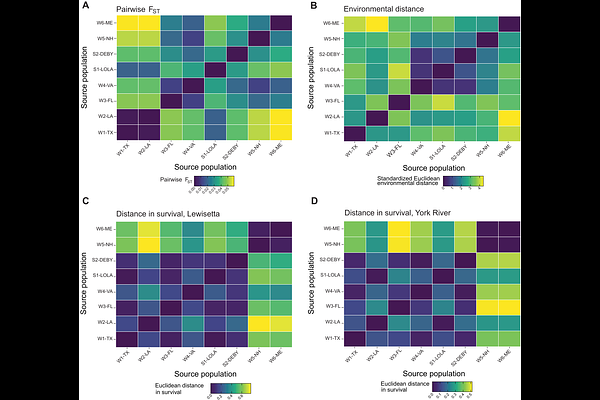
AbstractRestoration and management of natural populations often assume that local genotypes are best suited for transplantation to their local environment. Prioritizing a single local genotype, however, contrasts with the framework of maximizing intraspecific diversity to increase population resilience to environmental change. Local populations may also become maladapted to a rapidly changing environment, motivating alternative frameworks that instead minimize environmental distance between source and transplantation sites. Here, we tested the predictive power of the local is best, maximize intraspecific diversity, and minimize environmental distance frameworks on the survival and growth of Eastern oyster (Crassostrea virginica) genotypes in field common gardens that differed in salinity and disease pressure. Although a genome scan revealed patterns of adaptation to disease, heat stress, and salinity among source populations, we did not find strong support for the local is best framework: geographically distant southern genotypes performed comparably to local selection lines and a local wild population. Higher genetic diversity within monocultures was associated with higher survival, yet highly diverse polycultures survived at lower rates than the best-performing monocultures, providing mixed support for the maximize intraspecific diversity framework. Temperature and salinity of the environments-of-origin of parents predicted the survival of their offspring in common gardens, but the relationship between survival and environmental distance was context-dependent, leading to mixed support for the minimize environmental distance framework. Together, these results demonstrate that no single framework reliably predicted transplantation success, suggesting that effective management strategies may need to integrate genomic and environmental lines of evidence to guide genotype selection.