The importance of M1 muscarinic receptor phosphorylation in learning and memory

The importance of M1 muscarinic receptor phosphorylation in learning and memory
McFall, A.; Gibson, K.; Molloy, C.; Lindsley, C. W.; Tobin, A. B.
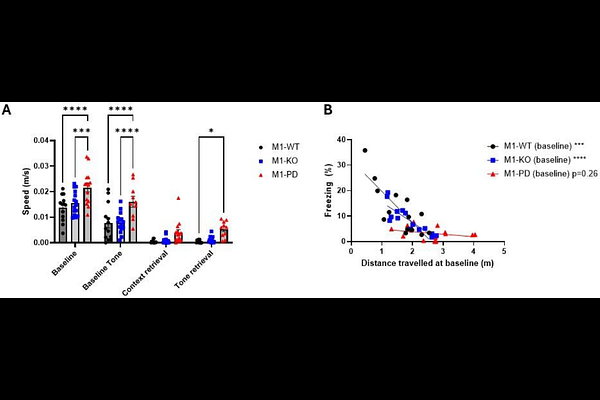
AbstractThe muscarinic acetylcholine receptor 1 (mAChR1, M1) has been identified as a primary target for Alzheimers disease (AD) and better understanding of the receptor biology, especially in regard to biased signalling of the receptor, will allow for the development of improved drugs targeting cholinergic dysfunction in AD. The aim of this study was to determine the contribution of phosphorylation of M1 to the learning and memory (LM) effects of M1 agonism. The contribution of M1 phosphorylation dependent signalling in LM was assessed using the mAChR1 positive allosteric modulator, VU0486846, in a scopolamine (1.5 mg/kg) induced LM deficit model in mice expressing HA-tagged M1 (M1-WT), phosphorylation deficient HA-tagged M1 (M1-PD), or mice deficient in M1 (M1-KO). LM was assessed using a fear conditioning (FC) testing paradigm where context and cued memory retrieval was measured 24 hrs after training and a higher level of freezing indicated intact memory. Results demonstrated that scopolamine induced a significant LM deficit in both context and cued retrieval in M1-WT mice which was partially rescued by VU0486846 confirming a contribution of M1 signalling in LM. The scopolamine induced deficit in contextual retrieval in M1-KO mice was not rescued by VU0486846, which is an M1 selective ligand, while scopolamine did not induce a deficit in cued retrieval in M1-KO mice. In M1-PD mice, scopolamine induced a LM deficit in contextual retrieval, however this was also not rescued by VU0486846 treatment. Similarly to M1-KO animals, M1-PD mice did not display a scopolamine induced deficit in cued retrieval. When freezing responses were compared across strains, M1-PD mice displayed a deficit compared to M1-WT and M1-KO mice in contextual retrieval, while both M1-PD and M1-KO mice displayed a deficit compared to M1-WT mice in cued retrieval. These results demonstrate that although M1 agonism can restore a LM deficit in both contextual and cued testing paradigms, only the cued retrieval response is dependent on the M1. Additionally, biased Gq M1 signalling is not sufficient to restore contextual memory and requires phosphorylation of the receptor. Furthermore, biased M1 signalling results in LM deficits not seen with KO of the receptor. Overall, these results reiterate the importance of considering the bias of ligands when developing M1 agonists for dementia in the future.