Whole forest in a pouch? Methods converge in uncovering wood ants fungal and bacterial microbiota

Whole forest in a pouch? Methods converge in uncovering wood ants fungal and bacterial microbiota
Siedlecki, I.; Kochanowski, M.; Bak, I.; Kolasa, M.; Buczek, M.; Nowak, K. H.; Blocka, Z.; Ploszka, Z.; Pawlowska, J.; Lukasik, P.; Wrzosek, M.
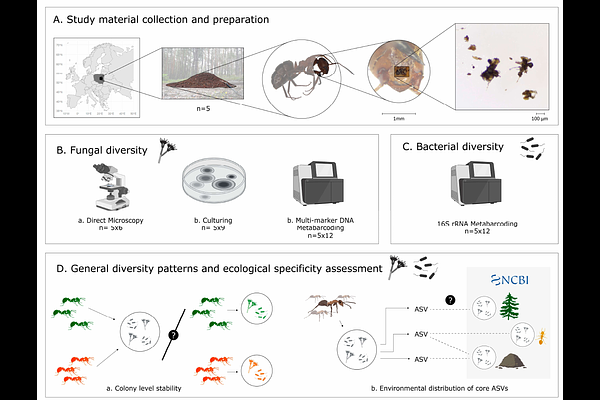
AbstractDespite their importance for individual fitness and population processes, the microbiota of many ecologically significant insects remains poorly explored. Even less is known about the interactions between microbial communities inhabiting insects and their surrounding environment. Ant infrabuccal pockets (IBPs), representing the interface between the digestive tract and the external environment, provide an opportunity to study these interactions. Here, we aimed to characterize ant-microbial interaction networks in the forest floor by profiling fungal and bacterial communities associated with the IBP of Formica polyctena ants, known as ecosystem engineers in temperate forests. We used direct microscopy, culturing, and sequencing amplicons of ITS1, ITS2, 18S rRNA marker regions to describe fungal communities, and 16S rRNA metabarcoding to characterize bacterial communities. Classical methods combined with a multi-marker amplicon sequencing allowed for a comprehensive description of the IBP microbiota. Fungal communities consistently contained representatives of 15 ecologically diverse genera, including insect-associated yeasts and primarily saprotrophic or endophytic fungi. Bacterial communities were dominated by genera previously reported from ant guts, mainly Bacilli and Alphaproteobacteria, and showed greater stability among ant colonies than fungal communities. Further studies on red wood ants IBP microbiota would enhance our understanding of their role in shaping ecological networks in forest ecosystems.