Bridging the gap with invasive imaging: promises and challenges of a new generation of ultrahigh resolution fMRI

Bridging the gap with invasive imaging: promises and challenges of a new generation of ultrahigh resolution fMRI
Knudsen, L.; Lazarova, Y.; Moeller, S.; Nothnagel, N.; Faes, L. K.; Yacoub, E.; Ugurbil, K.; Vizioli, L.
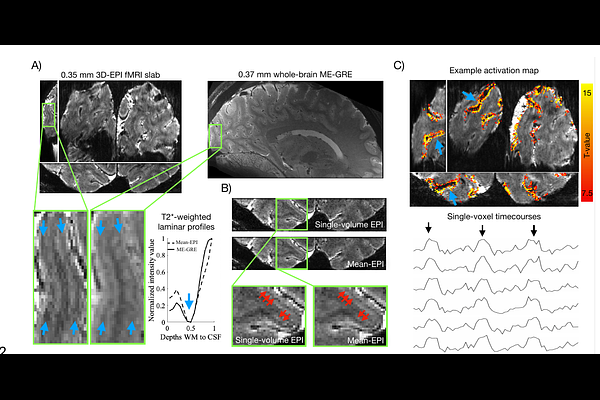
AbstractThe human neocortex is organized into six laminae forming the structural basis for feedforward and feedback connections across the brain, yet their functional contributions have remained largely inaccessible for non-invasive imaging methods. Leveraging the ultrahigh field of a 10.5 Tesla scanner, we acquired anatomical and functional MRI data at 0.37mm (~0.05 microliter) and 0.35mm (~0.04 microliter) isotropic resolution, respectively, approaching the scale of individual cortical layers in humans. Using the Stria of Gennari as an in-vivo anatomical landmark, we extend our previous finding that feedforward visual activation in layer IV of the primary visual cortex during visual stimulation was resolved in laminar BOLD profiles. These laminar features were reproducible across sessions and were not clearly visible with more typical 0.8 mm resolutions at 7T, underscoring the benefits of further increases in magnetic field strength and resolution. This imaging domain, however, comes with increasing challenges of distortion, alignment, and cortical depth estimation, which must be addressed and mitigated to realize its benefits. In this paper we discuss the promises and challenges of this new regime of high resolutions. Our findings showcase the potential of ultrahigh field, ultrahigh resolution human fMRI to bridge the gap with invasive imaging of cortical layers.