Validation and optimisation of wearable accelerometer data pre-processing for digital measure implementation and development

Validation and optimisation of wearable accelerometer data pre-processing for digital measure implementation and development
Langford, J.; Chua, J. Y.; Long, I.; Williams, A. C.; Hillsdon, M.
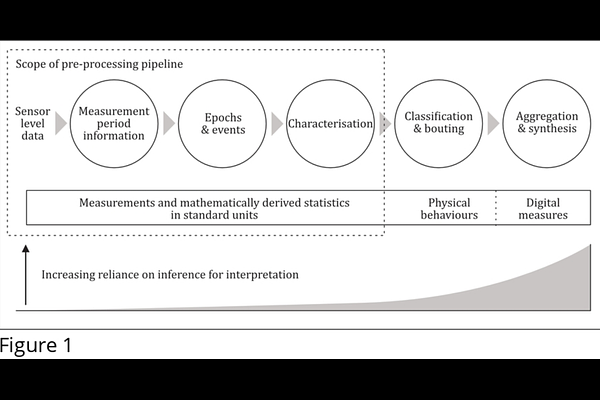
AbstractThe increasing use of accelerometers as digital health technologies in clinical trials and clinical care is driving the need for data processing to meet medical standards. The aim of this study was to create and test a modular pipeline for the pre-processing of high-resolution accelerometry that assures the quality, transparency and traceability of digital measures from sensor-level data. The objective is for the pipeline to be a foundational layer in the development, implementation and comparison of measures. The study developed the open GENEAcore package to meet the requirements of regulators, verifying the engineering implementation and analytically validating outputs against reference datasets. Early stages included the optimisation of calibration and non-wear detection. Data-driven detection of behavioural transitions was then validated to give direct bout outputs without the need to identify rules for epoch aggregation and interruptions. The utility for measure development was shown by comparing two algorithms for the characterisation of activity intensity in both the epoch and bout paradigms. Non-wear was detected with a balanced accuracy of 92.3% and the commonly used 13mg acceleration standard deviation threshold was empirically validated for the first time. The detection of transitions proved reliable with 99% detected, on average, within 2 seconds of their occurrence to give a mean expected event duration of 68.6s from a log-normal distribution. The different activity intensity algorithms were more than 99% concordant during movement but their outputs diverged in low movement conditions. Importantly, variable duration bouts created 31% higher daily activity durations compared to 1-second epochs. This evaluation of pre-processing steps has confirmed the attention to detail required to create robust and reproducible results for later clinical validation where small changes in an algorithm or its implementation may have clinically meaningful consequences.