Misleading Success: Genomes Reveal Critical Risks to European Gray Wolves

Misleading Success: Genomes Reveal Critical Risks to European Gray Wolves
Ravagni, S.; Battilani, D.; Salado, I.; Lobo, D.; Sarabia, C.; Leiva, C.; Caniglia, R.; Fabbri, E.; Ciucci, P.; Girardi, M.; Santos, F. I.; Kusak, J.; Mattucci, F.; Naderi, M.; Nowak, C.; Sekercioglu, C.; Skrbinsek, T.; Velli, E.; Stronen, A. V.; Vila, C.; Godinho, R.; Leonard, J.; Vernesi, C.
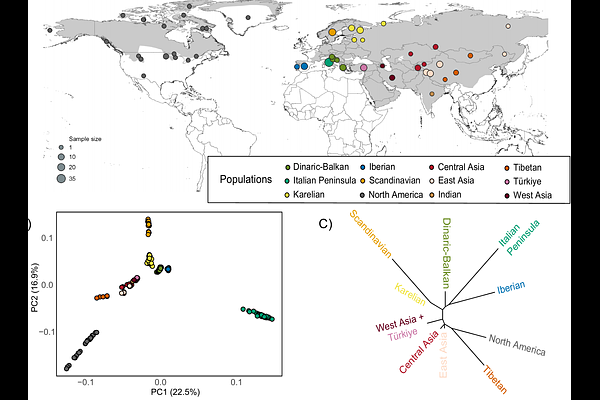
AbstractHave European gray wolves recovered? Despite an increase to ~21,000 wolves (Canis lupus), our genomic analyses reveal significant risks to their long-term viability. We analyzed over 200 whole-genomes spanning five major European populations. Rather than a single recovering population, European wolves form a mosaic of isolated, independently evolving lineages, mostly diverging in the late Pleistocene. All lineages have contemporary effective population sizes below the threshold for long-term viability (Ne [≥] 500) and show extensive inbreeding. Runs of homozygosity reveal population-specific inbreeding histories spanning recent to deep timeframes. Most lineages exhibit higher realized than masked genetic load, indicating emerging inbreeding depression. These findings challenge claims that downlisting European wolves is biologically warranted: none of these populations currently meets thresholds associated with favorable conservation status.