The Effects of Different Gait Patterns on Knee Joint Biomechanics and Dynamic Stability during Stair Walking in Healthy Adults

The Effects of Different Gait Patterns on Knee Joint Biomechanics and Dynamic Stability during Stair Walking in Healthy Adults
Yi, G.; Duan, L.; Sun, Y.; Wang, D.; Gao, Y.
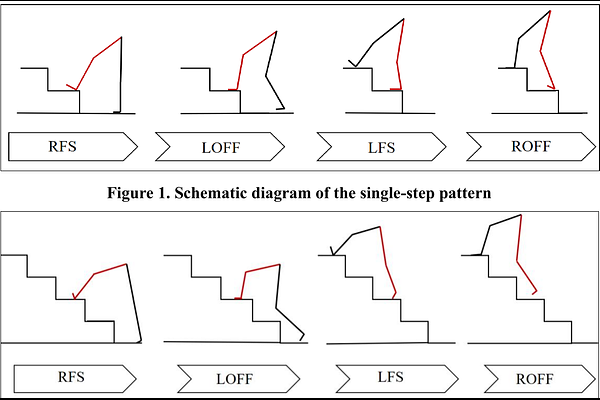
AbstractAbstract Objective: To investigate the effects of different gait patterns on knee joint biomechanics and dynamic stability during stair ascent. Methods: Fourteen healthy males were recruited to ascend stairs using two distinct gait patterns: the "single-step" (leading with the same leg) and "cross-step" (alternating legs) strategies. Kinematic and kinetic data were collected synchronously using a Qualisys infrared motion capture system and a Kistler 3D force plate. Dynamic stability was quantified using the Margin of Stability (MOS), and knee joint biomechanics were evaluated using Patellofemoral Joint Stress (PFJS) and other relevant metrics. Results: Throughout the gait cycle, there was no significant difference in the Medio Lateral (ML) MOS between the single-step and cross-step patterns (P=0.318). However, in the Anterior-Posterior (AP) direction, the MOS for both patterns remained negative and decreased over time, with the cross-step pattern exhibiting significantly lower AP MOS values than the single-step pattern (P=0.002). At the moment of left foot-off, significant differences were observed in the right knee joint angle, right knee joint moment, net joint moment, effective quadriceps muscle lever arm, Quadriceps Force (QF), the angle between the quadriceps tendon and patellar ligament, Patellofemoral Joint Force (PFJF), patellofemoral joint stress, and patellofemoral contact area (all P<0.001). Conclusions: During stair ascent, the cross-step pattern reduces body stability, thereby increasing the risk of backward falls. Furthermore, this pattern increases patellofemoral joint stress, subjecting the knee to greater loading. Therefore, it is recommended to enhance lower limb muscle strength through targeted training to reduce fall risk. Additionally, adopting a more cautious gait strategy (such as the single-step pattern) can help minimize patellofemoral joint loading and mitigate the risk of patellofemoral pain.