Tracing mobility among Eneolithic-Bronze Age Kurgan populations in the North Pontic steppe

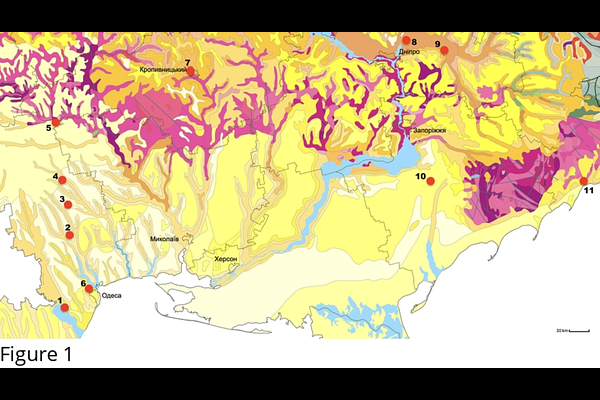
Tracing mobility among Eneolithic-Bronze Age Kurgan populations in the North Pontic steppe
Nikitin, A. G.; Renson, V.; Ivanova, S.; Neff, N. C.; Straioto, H.; Svyryd, S.
AbstractFive millennia ago, nomadic people from the North Pontic steppe left a profound impact on the course of Eurasian prehistory. However, little is known about their mobility patterns within their home region. To address this knowledge gap, we conducted a survey of the strontium isotope landscape of people interred in the 4th-3rd millennium BCE burial mounds (kurgans) of the western part of the North Pontic steppe. By analyzing the strontium signature in human bone and dentin, we established strontium baseline values for the region. We subsequently correlated enamel strontium ratios from 25 selected individuals with the baseline obtained and with published strontium data across the North Pontic steppe. Enamel strontium ratios show that some individuals interred in the northwest North Pontic fall within the regional baseline range, whereas others overlap with values reported for the eastern North Pontic steppe. In conjunction with carbon ({delta}13C) and nitrogen ({delta}15N) stable isotope data, we further determined that some individuals interred in the western Pontic steppe either spent the later part of life in the west Caspian steppe or were affected by physiological stress during lifetime. By integrating our data with published isotopic datasets, we produced a first baseline heatmap of the North Pontic steppe for the c. 4450-2100 BCE chronological period.