Modeling population control via tunable sex ratio distorter gene drives in Aedes aegypti

Modeling population control via tunable sex ratio distorter gene drives in Aedes aegypti
Childs, L. M.; Shabani, S.; Tauber, U.; Tu, Z.
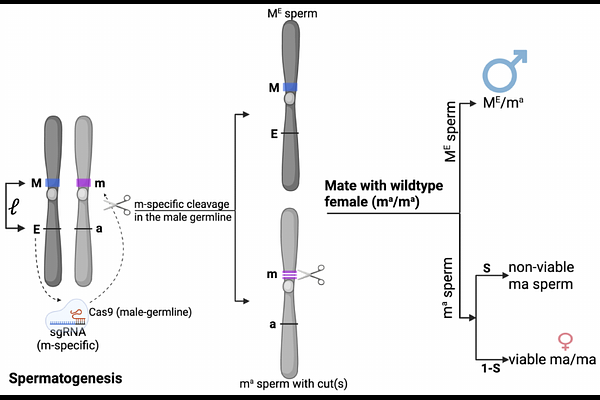
AbstractAedes aegypti is a major vector of arboviruses, and belongs to subfamily Culicinae, a diverse group of mosquitoes with homomorphic sex-determining chromosomes. Males are the heterogametic sex with a dominant male-determining locus (M locus). The M locus and its counterpart m locus are embedded in a region of suppressed recombination, with a large portion of this recombination desert showing significant molecular differentiation despite homomorphy. We developed a mathematical framework to examine M-linked genome editors that specifically target the m-chromosome during spermatogenesis, mimicking the naturally occurring sex ratio distorters (SRDs) in Culicinae that produce male-biased meiotic drives. Unlike previous models for species with heteromorphic sex chromosomes (e.g., X and Y), we incorporate features stemming from the homomorphic nature of the Ae. aegypti sex chromosomes such as varied linkage to the M locus, making the degree of super-Mendelian inheritance readily tunable. We evaluated \textit{in silico} SRDs with a range of M-linkage and editing efficiencies and established the theoretical foundation for developing highly efficient SRDs that outperform several methods of population suppression. These SRDs can be tuned to mitigate impact on a neighboring population. The framework developed here is suitable for exploring SRD-mediated genetic biocontrol of pests with homomorphic sex chromosomes.