Connexin 30 mutation rescues high-frequency hearing, reduces gap junctional coupling and alters potassium currents in cochlear Deiters cells

Connexin 30 mutation rescues high-frequency hearing, reduces gap junctional coupling and alters potassium currents in cochlear Deiters cells
Simoes, P.; Lukashkina, V. A.; Lukashkin, A. N.; Levic, S.; Russell, I. J.
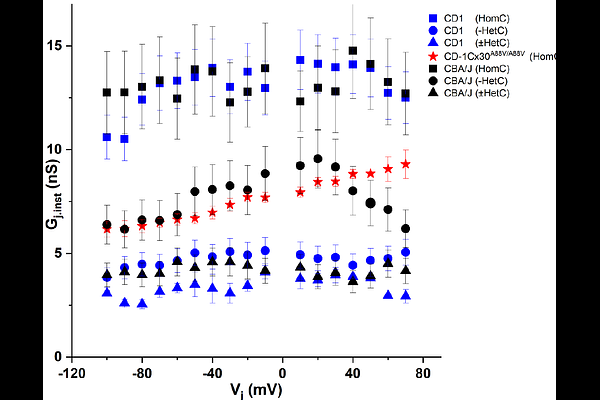
AbstractThe early-onset, high-frequency hearing loss phenotype of CD-1 mice is rescued by the A88V mutation of the connexin 30 gap-junctional protein, despite a reduced endocochlear potential (EP), which drives cochlear hair cell receptor potentials. The mutation enables organ of Corti (OoC) extracellular receptor potentials to be similar in size to those of sensitive-hearing CBA/J mice, presumably through increased OoC resistance, despite smaller intracellular outer hair cell (OHC) receptor potentials. Low-frequency hearing in CD-1Cx30A88V/A88V mice is impaired, compared with those of CBA/J and wild-type CD-1 mice. To investigate the cellular basis of OoC resistance increase and EP decrease, we made in situ electrophysiological measurements from Deiters cells (DCs) in the OoC of homozygous CD-1Cx30A88V/A88V mice. DCs contribute to the OHC cytoskeletal scaffold and cochlear K+ recycling, and are interconnected by syncytial junctions comprising connexins 30 and 26. Measurements from CD-1Cx30A88V/A88V mice were compared with those from wild-type CD-1 mice, with sensitive hearing below 12 kHz, and from the CBA/J strain. Syncytial junctional-coupling between DCs of CD-1Cx30A88V/A88V mice was weaker, input resistance greater, potassium current expression was modified, and voltage-sensitive activation was shifted to more negative values compared to those of CD-1 and CBA/J mice. Inactivating potassium currents dominate in DCs of CBA/J and CD-1Cx30A88V/A88V mice with excellent high-frequency hearing, and sustained currents dominate in DCs of CD-1 mice with early-onset hearing loss. These findings are discussed in relation to maintenance of OoC electrochemistry, rescue of early-onset hearing loss, impaired low-frequency hearing in CD-1Cx30A88V/A88V mice, and the basis of high-frequency hearing.