Cell-Type-Specific Bidirectional Modulation of the Cortico-Thalamo-Cortical Sensory Pathway by Transcranial Focused Ultrasound (tFUS)

Cell-Type-Specific Bidirectional Modulation of the Cortico-Thalamo-Cortical Sensory Pathway by Transcranial Focused Ultrasound (tFUS)
Gao, H.; Ramachandran, S.; Torregrossa, M. M.; He, B.
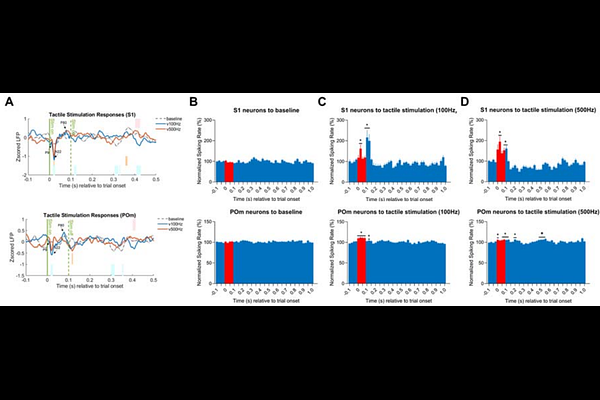
AbstractTranscranial focused ultrasound (tFUS) can noninvasively modulate sensory pathways, but the cell-type-specific mechanisms underlying excitatory or inhibitory effects remain unclear. Here, we investigate how tFUS applied to the somatosensory cortex (S1) influences S1 and posterior medial thalamic nucleus (POm) responses to hind paw vibration-tactile stimulation and which neuronal populations mediate these effects. Vibration-tactile stimulation evoked potentials (TEPs) and multi-unit activities (MUA) in S1 and POm were recorded from male rats. Optogenetic tagging was used to identify S1 CaMKII-positive, PV-positive, and SST-positive neurons, while waveform features were used to classify putative excitatory (i.e., regular-spiking units - RSUs) and inhibitory neurons (i.e., fast-spiking units - FSUs) in POm. We found that only S1 CaMKII-positive neurons and POm RSUs responded robustly to tactile stimulation. When tFUS was applied to S1, high pulse repetition frequency (PRF), high duty cycle, and high-pressure stimulation (etFUS) produced excitatory modulation of the sensory pathway, whereas low PRF, low duty cycle, and low-pressure stimulation (itFUS) induced inhibitory effects. Further analyses revealed that excitatory modulation was mediated by activation of S1 CaMKII-positive neurons, while the inhibitory effect arose from their deactivation. These findings demonstrate that tFUS exerts bidirectional, parameter-dependent modulation of a sensory pathway and highlight the critical role of CaMKII-positive neurons in mediating these effects. This study provides mechanistic insight into cell-type-specific neuromodulation by tFUS, particularly in bidirectional modulation of a sensory pathway, and informs the optimization of stimulation parameters for targeted therapeutic interventions.