Masking phosphatidylserine prevents neuronal loss in two distinct Drosophila models of neurodegeneration

Masking phosphatidylserine prevents neuronal loss in two distinct Drosophila models of neurodegeneration
Khateb, N.; Shwartsburd, M.; Grig, E.; Vogelesang-Ganon, S.; Fauzi, T.; Ayoub, M.; Hakim-Mishnaevski, K.; Kurant, E.
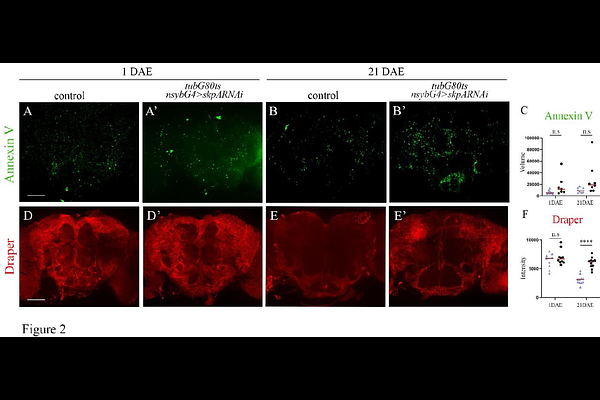
AbstractNeuronal loss is a hallmark of neurodegenerative diseases. Phosphatidylserine (PS), a key eat me signal, is exposed on stressed viable neurons, triggering their premature phagocytosis by activated glia. We investigated whether PS masking could serve as a universal strategy to prevent neuronal loss in two distinct Drosophila models of neurodegeneration: an adult-stage-specific knockdown of skpA and a Huntingtons disease model initiated during embryogenesis. Both models exhibit neuronal loss, motor dysfunction, and reduced lifespan. To mask PS, we used a truncated form of MFG-E8, a glycoprotein that binds PS without promoting engulfment. PS masking preserved two neuronal populations in both models, indicating that these neurons were eliminated alive via phagoptosis. Motor function and lifespan were improved to varying degrees, depending on the timing and severity of neuronal damage. These findings reveal that aberrant glial phagocytosis contributes to neuronal vulnerability and identify PS masking as a promising therapeutic approach for neurodegenerative diseases. Significance StatementNeuronal loss is a defining feature of neurodegenerative diseases, yet its underlying mechanisms remain incompletely understood. Here, we demonstrate in two Drosophila models of neurodegeneration that stressed but viable neurons are prematurely eliminated by glial phagocytosis through phosphatidylserine (PS) exposure. By masking PS with a truncated form of MFG-E8, we prevented neuronal loss, improved motor performance, and extended lifespan, highlighting PS-dependent removal of live neurons as a critical contributor to neurodegeneration. Our findings provide the first in vivo evidence that PS masking protects neurons in distinct neurodegenerative contexts, offering a broadly applicable strategy for therapeutic intervention. This work positions aberrant glial phagocytosis as a disease-driving mechanism and establishes Drosophila as a powerful model for dissecting neuron-glia interactions in neurodegeneration.