Somatic mutation landscape revealed by non-invasive iPSC derivation from urine cells

Somatic mutation landscape revealed by non-invasive iPSC derivation from urine cells
Bae, T.; Tomasini, L.; Klimczak, L. J.; Kayastha, M.; Suvakov, M.; Jang, Y.; Jourdon, A.; Gordenin, D. A.; Vaccarino, F. M.; Abyzov, A.
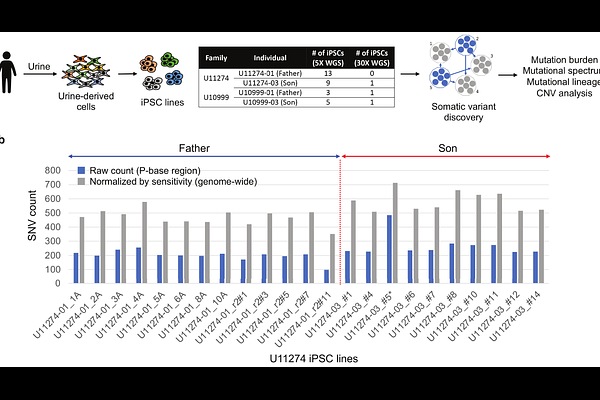
AbstractSomatic mutations that arise post-zygotically create genetic diversity among normal human cells and provide key insights into human development and aging. Fibroblast-derived induced pluripotent stem cells (iPSCs) have proved to be a useful system for disease modelling; however, due to their clonal nature, iPSC lines carry somatic mutations inherited from the founder cells, raising concerns about their genomic integrity. At the same time, this clonality enables single-cell level discovery of somatic mutations and the reconstruction of developmental lineages. In living individuals, though, this approach requires invasive biopsies and is limited to skin-derived lineages. Here, we generated 33 urine-derived iPSC lines from four males representing two father-son relationships, performed shallow whole-genome sequencing of the lines and analyzed somatic mutations. Derived iPSCs representing single cells from urine carried a few hundred of somatic single-nucleotide variants per genome, dominated by endogenous, clock-like mutational signatures and lacking environmental imprints such as UV-associated mutations. Copy-number analysis identified somatic CNVs in most of the lines and revealed higher CNV burdens in fathers than in sons, consistent with age-related structural mosaicism. Shared mutations across lines enabled reconstruction of cell lineage phylogenetic trees. In summary, urine-derived iPSCs showed genomic alterations comparable to those in fibroblast-derived iPSC lines and represent a valuable non-invasive alternative for disease modeling. Overall, this study provides the first genome-wide characterization of somatic mutations in urine-derived iPSCs and establishes them as a practical and non-invasive platform for charting somatic mutation landscapes and tracing developmental lineages in living humans.