Reduction of Complex Dynamic Touch information to a single stable perceptual feature

Reduction of Complex Dynamic Touch information to a single stable perceptual feature
Zamani, N.; Stephens-Fripp, B.; Tymms, C.; Chan, S.; Padakhtim, R.; Culburt, H.; Hartcher-O'Brien, J.
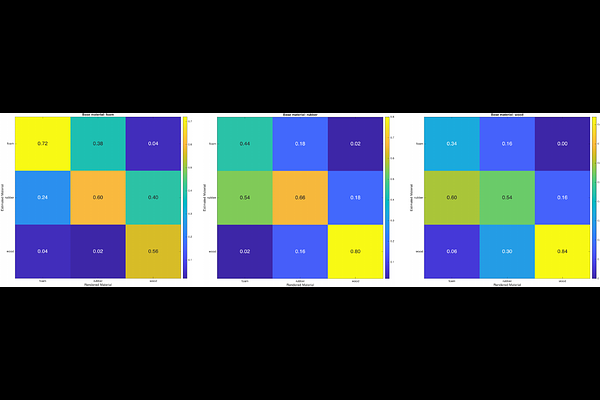
AbstractDynamic touch requires the perceptual system to extract stable material properties from complex, evolving signals. We show that the tactile system relies on total spectral energy, the overall vibratory power of contact induced transients, rather than waveform details or dominant frequency. Using a spectral energy compensation method, we conducted five psychophysical experiments in two degraded feedback scenarios: soft finger interfaces, where fingertip stiffness was reduced by an inflatable silicone bubble, and soft surface interactions, where participants tapped compliant foam surfaces. In both, participants reliably discriminated hardness and identified materials only when natural spectral energy profiles were preserved, independent of signal type. Judgments scaled systematically with energy level, and under conflicting cues, spectral energy dominated over frequency or compliance. These findings establish spectral energy as a governing cue in tactile perception, revealing a simple and robust computation akin to estimating mechanical work. This principle offers a generalizable framework for restoring touch in prosthetics, teleoperation, and immersive virtual environments.