Bidirectional communication between neurons in the mesentery and ileal myenteric neurons

Bidirectional communication between neurons in the mesentery and ileal myenteric neurons
Vanden Berghe, P.; Guo, F.; Van Mechelen, K.; Li, Z.; Fung, C.
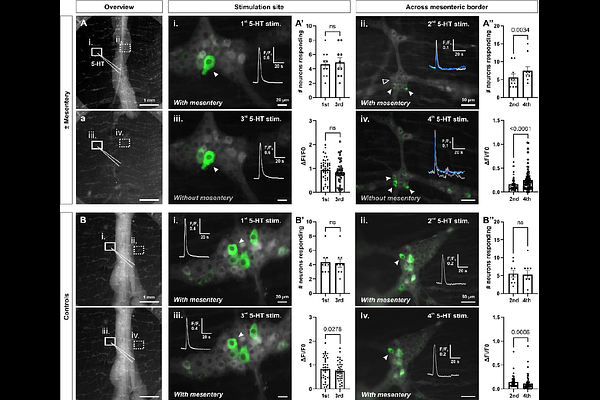
AbstractThe intestinal mesentery has been recently classified as a 'new' organ and contains various cell types including adipocytes, preadipocytes, endothelial cells, and immune cells. In addition, neuronal cell bodies are found in the small intestinal mesentery and are situated either individually or clustered together with glial cells in small ganglion structures close to the gut wall. However, little is known about the origin or function of these extra-intestinal mesenteric neurons. The aim of this study was to better these characterize mesenteric neurons and to examine their connectivity with the ENS using calcium imaging in adult mouse ileum with the mesentery attached. Here we show that neurons in the mesentery express typical ENS neurochemical markers, respond to 5-HT, ATP and the nicotinic agonist DMPP, and receive nicotinic synaptic inputs. Furthermore, using labeling with the neuronal tracer DiI, some mesenteric neurons were found to project into the gut wall and can provide functional excitatory inputs to myenteric neurons. By contrast, we did not find evidence for mesenteric neurons providing inputs to other extrinsic neuronal targets, suggesting that they preferentially interact with the ENS. Finally, we demonstrate that mesenteric neurons could be activated by intestinal distension and that the mesentery provides a source of inhibition to the myenteric plexus. Taken together, we show that the ENS not only interacts with vagal and spinal afferents, and sympathetic and parasympathetic nerves, but also neurons situated in the mesentery. Finally, our findings suggest that these neurons may provide a form of negative feedback to the myenteric plexus such as in the event of intestinal distension. These findings have important implications for the regulation of intestinal motility in physiological and pathophysiological conditions.