Estimation of adult census size from close-kin dyads in the malaria mosquito Anopheles gambiae

Estimation of adult census size from close-kin dyads in the malaria mosquito Anopheles gambiae
Lerch, A.; Small, S. T.; Hui, T.-Y. J.; Bascunan, P.; Dotson, E. M.; Lukindu, M.; Birungi, K.; Kayondo, J. K.; Burt, A.; Perkins, A.; Besansky, N. J.
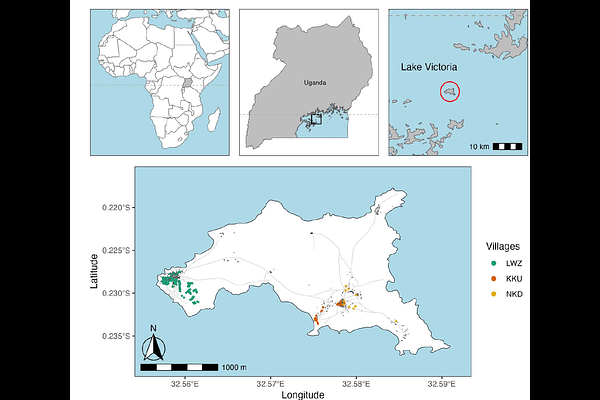
AbstractAccurate estimates of adult mosquito abundance are central to the design and evaluation of vector control strategies, yet they are difficult to obtain from natural populations. Conventional mark-recapture methods for estimating adult mosquito census size pose logistical and other challenges. A recently developed close-kin mark-recapture (CKMR) approach is a promising alternative. However, application of CKMR has been largely confined to long-lived vertebrates. Validation on empirical data from short-lived, highly fecund insects is lacking. Here, we apply CKMR to a natural population of Anopheles gambiae, the primary African malaria mosquito, sampled from a small island in Lake Victoria, Uganda. Using a high-diversity amplicon panel of genome-wide markers, we genotyped 714 adult mosquitoes collected over a 20-day period. We classified pairs to close-kin categories by implementing probabilistic latent-kinship estimation rather than using a deterministic threshold-based framework. We observe numerous full-sibling pairs but no parent-offspring pairs, a pattern indicative of extreme variance in reproductive success owing to frequent failure of mosquito egg clutches to produce adults. To adapt the CKMR framework to mosquito life history, we explicitly modeled the mosquito life cycle including the possibility of clutch failure. By incorporating probabilities of both parent-offspring and full-sibling relationships, we estimate an adult female census size of 26,887 (95% credible interval: 6,979 - 146,011), and a clutch failure probability of 97.6% (CrI: 91.3 - 99.6%). We use these estimates to calculate the predicted variance in reproductive success and effective population size. Through individual-based simulations we confirm our estimates and the necessity of modeling reproductive variance to explain observed kinship patterns. Our results demonstrate that CKMR can be applied successfully to mosquitoes, provided that appropriate adjustments are made to account for their natural history.