KELPE: knock-in exchangeable dual landing pad embryonic stem cells enable efficient screening of synthetic gene circuits

KELPE: knock-in exchangeable dual landing pad embryonic stem cells enable efficient screening of synthetic gene circuits
Fairweather, A.; Slavova, Y.; Malaguti, M.
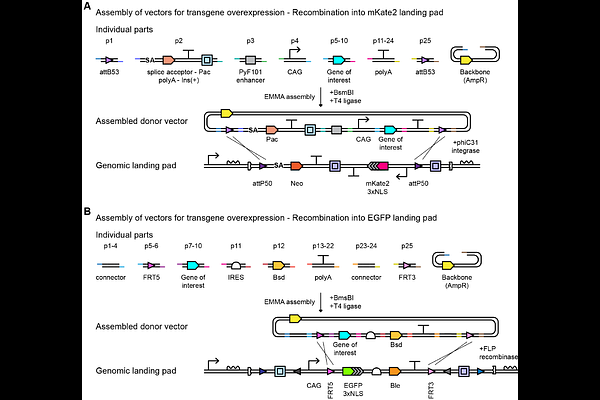
AbstractThe establishment of genetic circuits in pluripotent stem cells (PSCs) allows to model and manipulate developmental events. However, prototyping complex circuitry remains challenging, due to limitations in screening circuit components and transgene silencing. Here, we introduce KELPE: PSCs with two silencing-resistant insulated genomic landing pads targeted to genomic safe harbour sites. KELPE cells enable the stable integration of multiple transgenes into the same genomic region, facilitating fair comparisons of genetic circuit components. We demonstrate this by fine-tuning "synthetic neighbour-labelling" technologies. We first generate optimised PUFFFIN PSCs, which report on cell-cell interactions by fluorescently labelling wild-type neighbours. We then generate new synNotch "receiver" PSCs, which can trigger expression of any transgene following interaction with a synthetic ligand presented by "sender" cells of interest. We describe an optimised circuit syntax that abolishes ligand-independent transgene induction in receiver PSCs, and showcase this by synthetically programming cell death in receiver cells engineered to express a toxin following interaction with sender cells. In summary, we describe a new cell line that facilitates silencing-resistant transgene expression and prototyping of synthetic biology tools in a developmentally-relevant model.