Ancient Rapid Radiation Underlies Persistent Phylogenomic Conflict in Early Collembola Diversification

Ancient Rapid Radiation Underlies Persistent Phylogenomic Conflict in Early Collembola Diversification
Cucini, C.; Moody, E. R.; Cicconardi, F.; Montgomery, S. H.
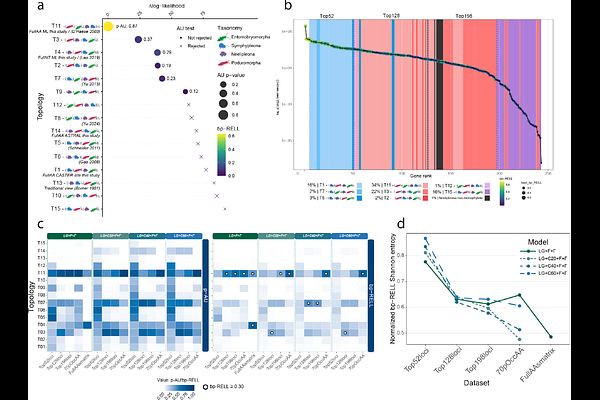
AbstractCollembola (springtails) are among the most abundant and ecologically important soil arthropods, representing one of the oldest extant terrestrial hexapod lineages, with a fossil record extending to the early Devonian. Despite their relevance, phylogenetic relationships among the four extant orders (Entomobryomorpha, Poduromorpha, Symphypleona, and Neelipleona) have remained unresolved for over two decades. Here, we present the most comprehensive phylogenomic analysis of Collembola to date, comprising 1,127 single-copy orthologues from 145 taxa representing 19 families. To improve orthology inference, we developed a novel HMM-based filtering pipeline that significantly reduced hidden paralogy in BUSCO-derived datasets. Across multiple dataset configurations, gene-jackknife replicates, and various maximum-likelihood analyses, we consistently recovered Poduromorpha as the earliest-diverging lineage. Coalescent-based methods instead highlighted discordant arrangements characterised by extremely short internal branches and low quartet support, a pattern consistent with pervasive incomplete lineage sorting and reticulate evolutionary history. We further dissected the phylogenetic signal by exhaustively evaluating all possible inter-order topological arrangements, both on the full concatenated dataset and gene-by-gene, to identify the most phylogenetically informative loci. These analyses rejected the great majority of previously proposed hypotheses, narrowing support to only two statistically indistinguishable topologies (T11 and T4), with the Poduromorpha-first arrangement consistently favoured across both site-homogeneous and site-heterogeneous substitution models. Finally, with molecular dating, we estimated the origin of crown Collembola in the Early Devonian, with the diversification of the extant orders in the Carboniferous. Several extant genera were estimated to be older than many currently recognized families, highlighting the exceptional evolutionary persistence of springtail lineages and suggesting that lineage longevity should be considered when interpreting higher-level taxonomic diversity.