Lateral entorhinal cortex supports behaviorally-induced hippocampal ensemble stability for reliable memory recall

Lateral entorhinal cortex supports behaviorally-induced hippocampal ensemble stability for reliable memory recall
Hopkins, M. D.; Rahal, P.; Robert, V.; Kim, E.; Basu, J.
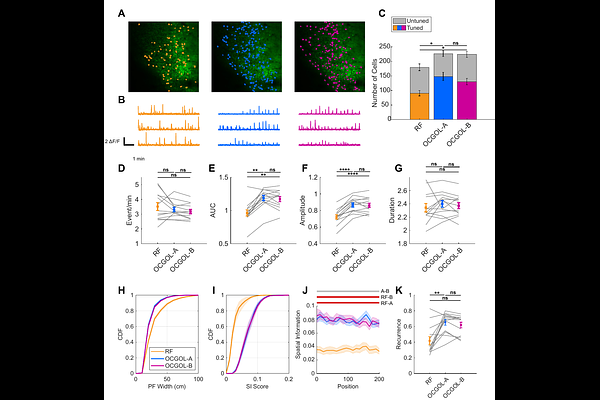
AbstractHippocampal pyramidal neurons function as place cells, showing location-specific activity during navigation, to form an internal spatial map of the environment. They are hypothesized to be the neural substrate of episodic memory. However, place cell receptive fields tend to drift or have poor tuning in low demand tasks, lacking operant goals such as random foraging, or in sensory context-deprived environments. Through chronic two-photon calcium imaging of hippocampal area CA1, we directly compare stability in a low versus a high demand task within the same animals over the course of learning and recall in the same environment. We find that compared to random foraging, an odor-context based navigational task stabilizes place cell representations and increases place cell quality and quantity. To investigate the circuit mechanism that may support this stability, we manipulated the activity of lateral entorhinal cortex (LEC) excitatory neurons, which provide both indirect and direct multisensory inputs about context, odor, and time to CA1. We chemogenetically suppressed activity of excitatory neurons in LEC during recall of the odor-context based navigation task and found that context discrimination is impaired at both the behavioral and neural level. With LEC silencing, mice had lower behavioral performance, less stable population activity, and greater similarity between opposing trial types. Our study finds that increasing task demand increases CA1 stability and that this stability is partially supported by LEC.