Tubulin polyglutamylation modulates Golgi morphodynamics and neurite branching during neuronal morphogenesis

Tubulin polyglutamylation modulates Golgi morphodynamics and neurite branching during neuronal morphogenesis
Hsu, C.-H.; Kinrade, A. J.; Cohen, S.
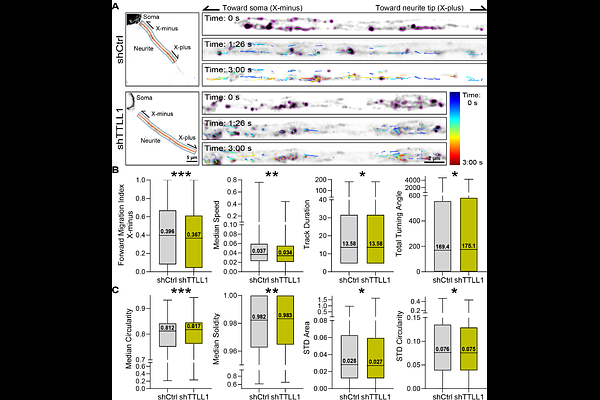
AbstractNeurons establish functional networks through morphological remodeling during neuronal differentiation. Microtubule polyglutamylation is a key microtubule post-translational modification that is highly enriched during this process and plays an important role in differentiation. However, how remodeling of organelle features such as morphology, distribution and interactions depend on tubulin polyglutamylation during neuronal differentiation remain unclear. Here, we employed multispectral imaging combined with quantitative 3D organelle analysis to comprehensively profile eight organelles simultaneously in human induced pluripotent stem cell-derived neurons. We discovered that depletion of tubulin polyglutamylation induces pronounced alterations in somatic Golgi morphology and associated organelle interactions. In addition, Golgi-derived compartments in proximal neurites exhibited altered morphology and dynamics, namely decreased retrograde directionality. These changes were accompanied by increased neurite branching and tortuosity. Together, our findings reveal a previously unrecognized role for tubulin polyglutamylation in coordinating organelle organization with neurite architecture, providing a mechanistic link between tubulin post-translational modification, Golgi morphology, dynamics, and neuronal morphogenesis.