Multiscale reorganization of brain and behavior under large-scale electrical perturbation

Multiscale reorganization of brain and behavior under large-scale electrical perturbation
Kreuzer, S.; Dukart, J.; Hansen, J. Y.; Nguyen, H. K.; Bentsch, M.; Zieger, S.; Sakreida, K.; Baghai, T. C.; Nothdurfter, C.; Groezinger, M.; Draganski, B.; Misic, B.; Bzdok, D.; Eickhoff, S. B.; Poeppl, T. B.
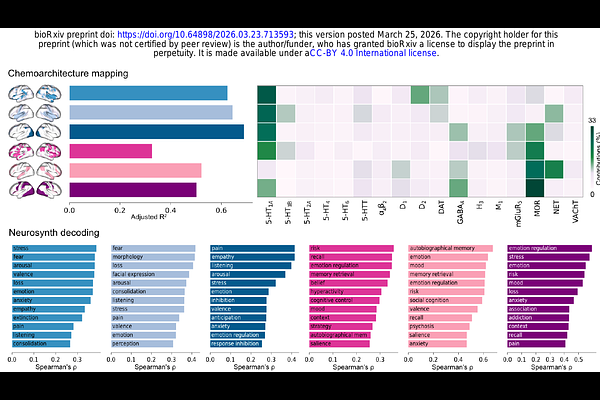
AbstractLarge-scale electrical perturbation of the human brain provides a unique model for understanding how multiscale biological constraints shape behaviorally relevant reorganization. Here, we integrate longitudinal neuroimaging coordinates from 148 experiments ({approx}2,300 subjects) with normative connectomics, chemoarchitecture, intrinsic electrophysiology, and transcriptomics to identify cross-scale principles governing human brain reconfiguration under strong perturbation. Convergent hubs of structural and functional plasticity embed within default-mode and salience systems and show complementary coupling to visual networks, linking perturbation-induced change to large-scale circuits supporting affective regulation, memory, interoception, and psychosis-relevant processes. These macroscopic patterns align with intrinsic cortical dynamics and chemoarchitectural gradients dominated by 5-HT1A receptors, with additional contributions from D2, -opioid and GABAA systems, and are enriched for astrocytic and microglial gene expression, implicating glial plasticity in systems-level reorganization. Finally, in a separate intervention dataset, regularized statistical-learning models demonstrate that this multiscale signature tracks behaviorally relevant symptom change specifically under strong electrical perturbation. Together, these results outline general organizing principles linking molecular, cellular and network-level constraints to human behavioral adaptation, providing a computational framework for understanding how large-scale perturbations reshape brain systems across levels of biological organization.