Cell Cluster Geometry and Fluidity Control the Transition from Single-Cell Chemorepulsion to Collective Chemotaxis

Cell Cluster Geometry and Fluidity Control the Transition from Single-Cell Chemorepulsion to Collective Chemotaxis
Sanoria, M.; Engra, G. M.; Scita, G.; Gov, N.; Gopinathan, A.
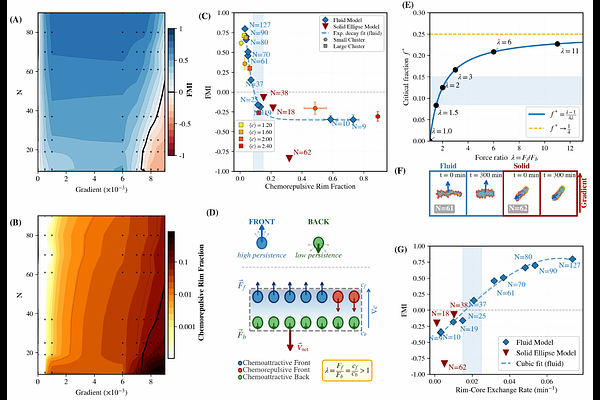
AbstractDirected migration along chemical gradients controls immune surveillance, development, and cancer invasion. However, the same chemical cue can produce different responses depending on its concentration and whether cells move alone or in groups. For example, in steep gradients, isolated malignant lymphocyte cells migrate away from the chemoattractant source, whereas clusters of the same cells continue to migrate toward it. Here, combining computational modeling and experimental observations, we show that this reversal is governed by coupled mechanisms acting across molecular, cellular, and collective scales. At the single-cell level, our model predicts that receptor endocytosis generates a feedback that produces a nonmonotonic surface receptor density with increasing chemoattractant concentration. Above a critical concentration that depends on the cell's volume-to-sensing-area ratio, receptor depletion reverses cell polarity and drives chemorepulsion. However, in clusters, cell-cell contacts reduce the membrane area exposed to ligand, increasing the volume-to-sensing-area ratio, thus increasing the critical concentration and preserving chemotaxis. An agent-based model incorporating these mechanisms quantitatively reproduces the sign reversal of the migration index across gradient steepness and cluster size. We show that collective rearrangements further stabilize chemoattraction with exchanges between the cluster rim and core helping remove chemorepulsive cells from the leading edge, keeping their fraction below the threshold required to reverse cluster migration. The model further predicts, and experiments confirm, that increasing ambient ligand concentration while keeping the gradient fixed reduces cluster chemoattraction. Our results identify receptor trafficking, cell geometry, and cluster fluidity as physical determinants of collective directional decision-making, with implications for immune cell homing, tissue morphogenesis, and cancer dissemination.