Clove Aqueous Extract Triggers a Multi-Organellar Stress Crisis through Lysosomal Destabilisation and Mitochondrial Hyperpolarisation to Suppress Patient-Derived Ovarian Cancer Cells

Clove Aqueous Extract Triggers a Multi-Organellar Stress Crisis through Lysosomal Destabilisation and Mitochondrial Hyperpolarisation to Suppress Patient-Derived Ovarian Cancer Cells
Ghanem, Y.; Odwan, H.; Yang, M.; Malone, V.; Alenazi, F.; Abu Saadeh, F.; Gray, S. G.; Doherty, D.; Martin, C.; O`Toole, S.; O`Leary, J. J.; Mohamed, B. M.
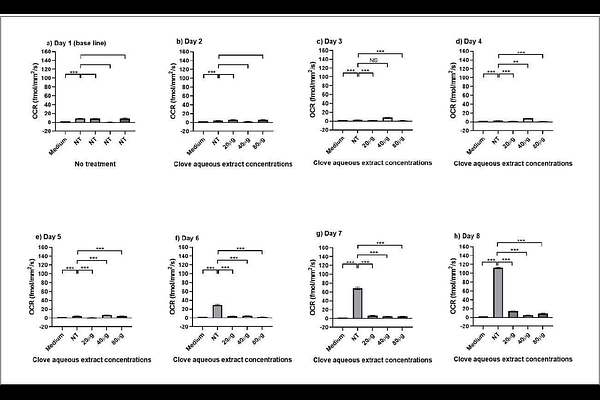
AbstractOvarian cancer (OC) remains a lethal malignancy with limited therapeutic options, underscoring the need for the identification of novel agents. Natural products like clove (Syzygium aromaticum) have shown promising anti-cancer activity, but their mechanism in OC is poorly understood. This study investigates the anti-tumour effects and underlying mechanisms of a clove aqueous extract (CAE) on a panel of patient-derived OC cells. We found that CAE significantly inhibited cellular proliferation and induced cell death in a time- and dose-dependent manner. Mechanistically, CAE induced profound cellular stress, activating the transcription factor ATF-2. This was accompanied by a significantly increased lysosomal stress response, as evidenced by increased lysosomal mass/acidity, and a pathogenic hyperpolarisation of the mitochondrial membrane potential ({Delta}{Psi}m). The bioenergetic crisis induced as a consequence resulted in a sharp reduction in cellular oxygen consumption rate (OCR). Notably, the sensitivity to CAE-induced lysosomal and mitochondrial dysfunction varied across cell lines, revealing distinct phenotypic responses. Our results demonstrate that clove extract exerts its anti-tumour effects by orchestrating a multi-organellar stress response, positioning lysosomal disruption as a central event in its mechanism of action. This study provides a strong rationale for the further development of clove-based interventions for OC.