Gene-specific exponent-corrected normalization for library size in bulk RNA-seq

Gene-specific exponent-corrected normalization for library size in bulk RNA-seq
Yin, R.; Li, D.; Zong, W.; Ketchesin, K. D.; Seney, M. L.; McClung, C. A.; Baldoni, P. L.; Tseng, G. C.
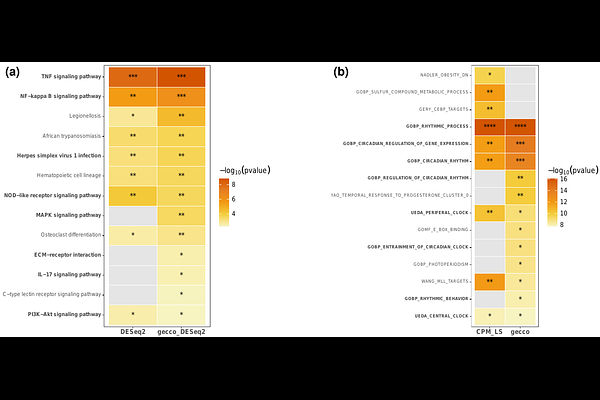
AbstractCorrecting for library size is an essential step in bulk RNA-seq analyses, as differences in sequencing depth across samples can obscure biological signal with technical noise. While numerous normalization methods and model-based strategies have been proposed, we demonstrate here that library size-normalized counts and differential expression results obtained from such widely adopted approaches often remain strongly correlated with library size in large-scale RNA-seq experiments. Through a systematic analysis of over 100 publicly available GEO and TCGA RNA-seq datasets with raw count data, we show that library size association is observed for a substantial proportion of genes even after state-of-the-art library size correction approaches recommended by leading normalization tools. To address this issue, we propose gecco, a gene-specific exponent-corrected normalization method for RNA-seq counts that incorporates library size directly into the statistical framework via a gene-specific correction term, rather than applying a uniform adjustment factor across all genes. This formulation generalizes existing normalization approaches and yields normalized counts that are free of residual library size effects. Using both simulation studies and real large-scale RNA-seq datasets, we show that our method mitigates library size bias while preserving biological signal across a range of parameter settings. We further demonstrate that our approach leads to higher detection accuracy and more biologically meaningful pathway enrichment results in downstream differential expression and rhythmicity analyses without compromising false discovery rate control. Our method is implemented in R and is fully compatible with the widely used differential expression analysis methods DESeq2 and edgeR.