The human leukemic fusion protein MLL-AF4 promotes autophagy and cell death in the fat body of Drosophila melanogaster

The human leukemic fusion protein MLL-AF4 promotes autophagy and cell death in the fat body of Drosophila melanogaster
Haukeland, A. L. C.; Johannessen, J. A.; Brathen, N. R.; Bergeron, P.; Formica, M.; Enserink, J. M.; Knaevelsrud, H.
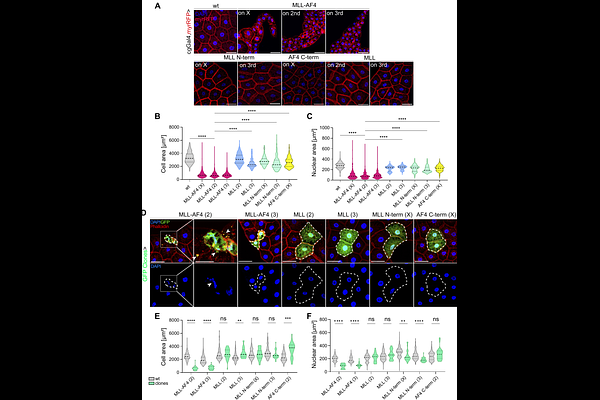
AbstractMLL-rearranged (MLLr) leukemia is an aggressive form of acute leukemia driven by chromosomal translocations fusing MLL with one of more than 100 partner genes, most commonly AF4. We previously showed that expression of the human MLL-AF4 fusion protein in the larval hematopoietic system of Drosophila melanogaster promotes hyperproliferation. Here, we report that the same oncogene elicits a strikingly opposite response in the larval fat body, inducing cell shrinkage, autophagy, and caspase-dependent cell death in a manner dependent on the intact fusion protein. Autophagy induction preceded caspase activation, yet the two programs operated in parallel rather than in series. Mechanistically, MLL-AF4-expressing fat body cells displayed elevated AMPK phosphorylation and reduced mTORC1 activity, and depletion of AMPK abolished caspase activation. Despite producing opposite phenotypes, both tissue-specific responses depended on conserved complex partners, suggesting that MLL-AF4 co-opts a shared mechanism to produce starkly different outcomes depending on cellular context. Uncovering how MLL-AF4 induces apoptosis-like phenotypes in the fat body could potentially be used to rewire leukemic signaling and remove malignant cells.