Lenacapavir prevents production of infectious HIV-1 by abrogating immature virus assembly.

Lenacapavir prevents production of infectious HIV-1 by abrogating immature virus assembly.
Ricana, C. L.; Brancato, S. G.; Highland, C. M.; Ekbataniamiri, F.; Ambrus, K.; Rey, J. S.; Faerch, M.; Torbett, B. E.; Perilla, J. R.; Dick, R. A.
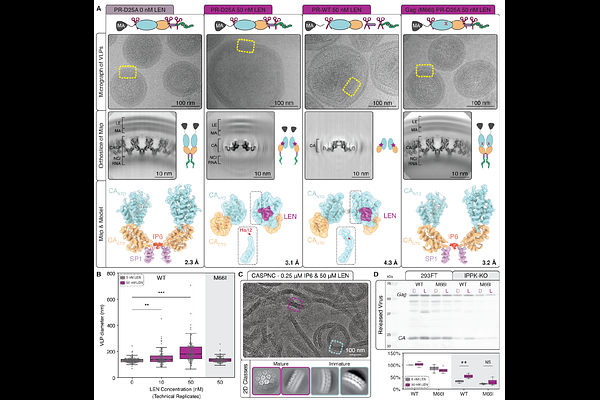
AbstractThe HIV-1 capsid effector Lenacapavir (LEN) acts by disrupting the early (reverse transcription and nuclear entry) and late (assembly and maturation) stages of the viral lifecycle. The early stage requires an intact Capsid consisting of a lattice of capsid protein (CA) hexamers and pentamers. Phenylalanine-Glycine (FG) containing nuclear pore proteins interact with Capsid hexamers at their FG pockets, facilitating nuclear entry. Disruption of Capsid lattice stability, or competitive binding to the FG pocket, by LEN blocks infection. Here, we provide insight into the effects of LEN on the late stage. Using a combination of cryo-EM structure determination, in vitro assembly, and in situ viral assays, we determined that treatment of producer cells with LEN abrogates the production of infectious virus via multiple mechanisms. Previous studies have shown that HIV-1 produced from LEN treated cells have improperly formed Capsids. However, how LEN interacts with the CA domain of the Gag polyprotein during assembly, prior to maturation, is unclear. Using a viral protease (PR) defective HIV-1 clone, which traps the Gag lattice in an immature state, we found that LEN dramatically remodulates the CA domain. The resulting CA layer was mature-like despite the absence of PR cleavage. We dubbed this unnatural state as "premature" lattice. Proper immature and mature lattice formation requires inositol hexakisphosphate (IP6), but our cryo-EM work revealed a lack of IP6 in the premature lattice. These findings provide insight into the mechanisms by which LEN prevents infectious HIV-1 production.