CTCF-mediated cis-regulatory chromatin insulation enforces a central B-cell tolerance checkpoint

CTCF-mediated cis-regulatory chromatin insulation enforces a central B-cell tolerance checkpoint
Gomes, D.; Gitelman, E.; Levin-Klein, R.; Golberg, A.; Haj-Yahia, A.; Hecht, M.; Avidov, B.; Castellani, F. M.; Halaseh, L.; Azria, B.; Golov, A. K.; Freund, N.; Murre, C.; Kaplan, N.; Drier, Y.; Bergman, Y.
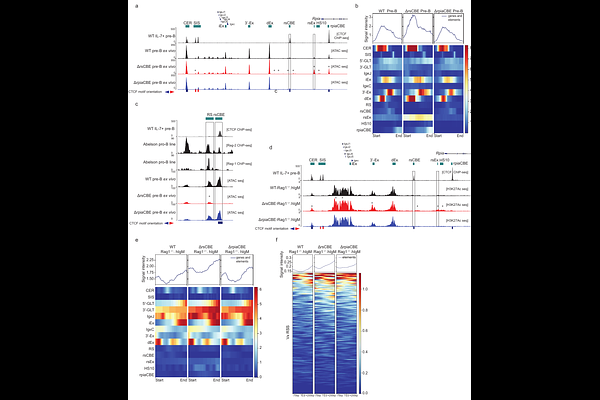
AbstractThe generation of a diverse and self-tolerant B cell repertoire is essential for adaptive immunity and is achieved through V(D)J recombination. In mice, Ig{kappa} is the dominant light chain, whereas Ig{lambda} rearrangement typically occurs in response to nonproductive or autoreactive Ig{kappa} recombination, a process termed receptor editing. Recombination at the RS element deletes the Ig{kappa} constant exon, silencing the locus and enabling Ig{lambda} expression. However, the epigenetic regulatory framework that orchestrates and governs receptor editing remains poorly defined. Here, we identify a CTCF-binding insulator element (CBE) within the 3' Ig{kappa} super-enhancer (3'-SE{kappa}) that regulates receptor editing and directs the {kappa}-to-{lambda} switch required for Ig{lambda} B-cell development. Mechanistically, loss of this CBE activates an insulated enhancer within the 3'-SE{kappa}, causing aberrant V{kappa} rearrangements and altered chromatin interactions through disrupted loop extrusion dynamics. Notably, loss of this CBE in mice leads to increased autoantibody production by ten weeks of age, demonstrating that CBE-mediated chromatin architecture shapes B cell fate by constraining autoreactive potential. Collectively, our findings define a novel CTCF-dependent cis-regulatory insulation checkpoint that connects chromatin loop extrusion to antigen-driven receptor editing, thereby enforcing B-cell tolerance.