Barcode-integrated reverse transcription for accurate, complete, and low-input RNA sequencing

Barcode-integrated reverse transcription for accurate, complete, and low-input RNA sequencing
Chen, W.; Zhu, Y.; Weng, X.; Jiang, Q.; Zhao, Q.; Than, J.; Baruch, M.; Zhang, D. Y.
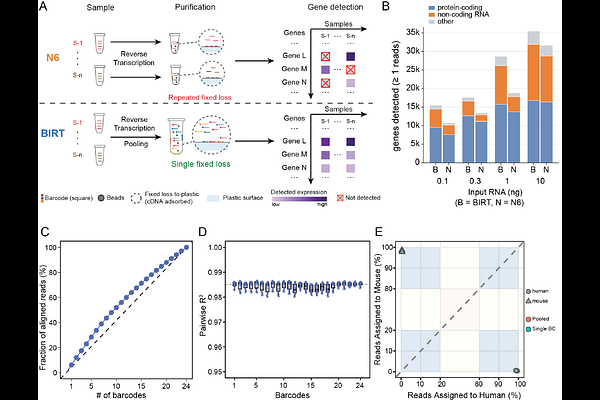
AbstractIn conventional total-RNA sequencing, unwanted RNA is removed by ribosomal-RNA depletion or messenger-RNA enrichment, and contaminating genomic DNA is cleared by DNase, both before reverse transcription. A sample index is added only later, during amplification, so each sample is carried through reverse transcription and cleanup on its own. These steps lose material that low-input samples cannot spare, and the per-sample handling limits throughput. Here we describe BIRT (Barcode-Integrated Reverse Transcription), a hairpin primer that carries a sample barcode and begins reverse transcription preferentially at RNA 3' ends, folding both barcoding and 3'-end capture into first-strand synthesis. Barcoding at reverse transcription enables early pooling, so samples are combined before any cleanup. It also authenticates RNA against DNA contamination: the primer barcodes RNA 909-fold more often than genomic DNA, and non-barcoded reads, which report DNA, are discarded. The 3'-end preference recovers terminal sequence that random priming loses: for a typical small nucleolar RNA, 66% of reads begin within two nucleotides of the mature 3' end, against a few percent for random hexamers. We pair BIRT with PERD (Probes for Excess RNA Depletion), a modular set of blocking probes that removes unwanted RNA within the same reaction without distorting expression (Pearson r = 0.98). We have applied BIRT to 8,079 samples across seven species, from cultured cells and primary tissue to FFPE and extracellular-vesicle RNA.