AI-guided design of candidate BMPR1A-binding peptides for cartilage regeneration: a multi-tool computational benchmarking study

AI-guided design of candidate BMPR1A-binding peptides for cartilage regeneration: a multi-tool computational benchmarking study
Ahmadov, A.; Ahmadov, O.
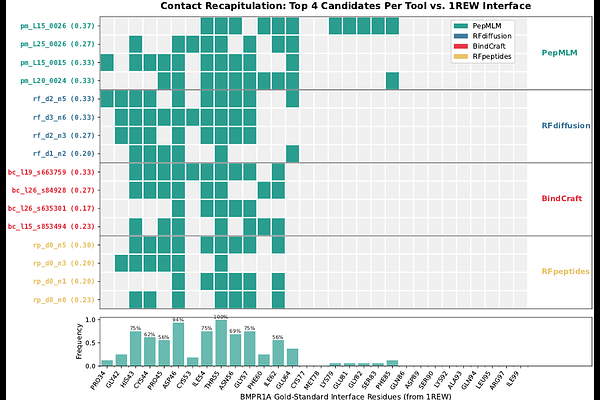
AbstractBone morphogenetic protein receptor type IA (BMPR1A) is a key mediator of chondrogenesis and a validated therapeutic target for cartilage repair, yet existing BMP mimetic peptides suffer from low potency and the full-length protein (rhBMP-2) carries significant safety risks. Generative AI tools for protein design can now produce de novo peptide binders, but none have been applied to cartilage regeneration targets. Here, we benchmarked four architecturally distinct AI tools--RFdiffusion, BindCraft, PepMLM, and RFpeptides--to design candidate BMPR1A-binding peptides. We generated 192 candidates alongside 98 negative controls (290 total) and evaluated all complexes using AlphaFold 3 structure prediction, dual physics-based energy scoring (PyRosetta and FoldX), and contact recapitulation against the crystallographic BMP-2:BMPR1A interface (PDB: 1REW). A four-metric composite ranking identified a 15-residue PepMLM design (pepmlm_L15_0026) as the top candidate, combining favorable binding energy (PyRosetta dG_separated = -45.9 REU; FoldX DeltaG = -19.4 kcal/mol) with the highest contact recapitulation among top-ranked peptides (11/30 gold-standard interface residues). Designed candidates significantly outperformed controls on ipTM (p = 0.002) and FoldX DeltaG (p < 0.001). BindCraft candidates achieved the highest structural confidence (ipTM up to 0.81) but exhibited moderate contact recapitulation (mean 0.224), consistent with the computational hypothesis that they may engage alternative BMPR1A binding surfaces rather than the native BMP-2 interface. Physicochemical filtering yielded a shortlist of 54 candidates across all four tools. These results establish a reproducible computational framework for AI-guided peptide design targeting cartilage regeneration and identify specific candidates for future experimental validation via binding assays and chondrocyte differentiation studies.