CXCR6 marks polyfunctional effector CD4 T cells required for anti-Chlamydia immunity in the female reproductive tract

CXCR6 marks polyfunctional effector CD4 T cells required for anti-Chlamydia immunity in the female reproductive tract
Mercado, M. A. B.; Kim, Y.; Li, Q.; Li, L.-X.
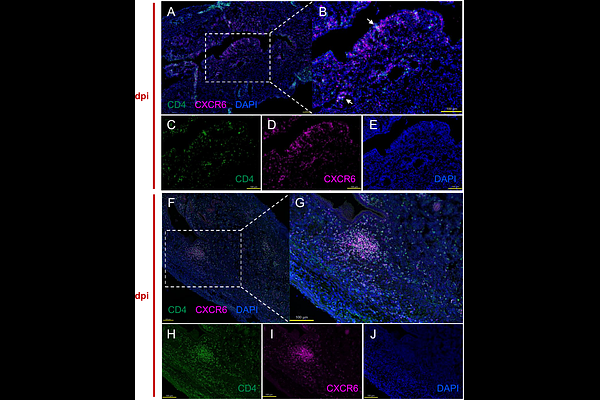
AbstractCD4 T cells are essential for protective immunity against Chlamydia in the female reproductive tract (FRT), yet the characteristics of protective mucosal effector CD4 T cells remain poorly defined. We previously identified the transcription factor BHLHE40 as a key regulator of polyfunctional effector CD4 T cell differentiation during Chlamydia infection. Here, we identify the chemokine receptor CXCR6 as a marker of these protective T cells. Following intravaginal Chlamydia muridarum infection, Bhlhe40-deficient mice exhibited reduced frequencies of CXCR6 CD4 T cells that correlated with impaired bacterial control. CXCR6 expression on T cells was associated with loss of stem-like features and acquisition of an effector phenotype. Compared with CXCR6- cells, CXCR6 CD4 T cells displayed enhanced proliferation and polyfunctionality by co-producing cytokines IFN-{gamma}, IL-17A, and GM-CSF. Although CXCR6 was dispensable for CD4 T cell homing to the FRT, it promoted localization to the infected epithelium and the emerging memory lymphoid clusters. Importantly, depletion of CXCR6 CD4 T cells reduced polyfunctional effectors and impaired bacterial clearance. Collectively, these findings identify CXCR6 as a marker of protective polyfunctional CD4 T cells and implicate CXCR6-dependent tissue positioning as a key component of effective mucosal immunity, highlighting CXCR6 as a potential biomarker for Chlamydia vaccine development.