The Risk of Gulf Birds Functional Diversity Loss with Climate Change Uncovered Using Deep Learning Population Models

The Risk of Gulf Birds Functional Diversity Loss with Climate Change Uncovered Using Deep Learning Population Models
Li, L.; Bai, J.; Sun, S.; Zuzuarregui, M.; Wang, Z.
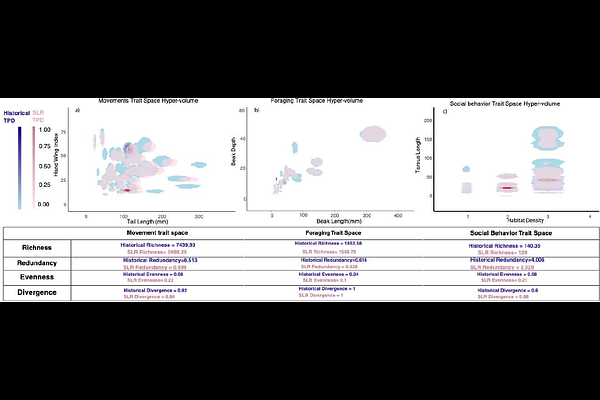
AbstractClimate change and sea-level rise (SLR) pose increasing threats to coastal ecosystems and biodiversity in the Gulf of America. Most efforts to anticipate these threats focus on species counts or range shifts, while changes in species functional diversity remain uncovered. We estimated climate change and sea level rise impacts on hundreds of bird species populations and corresponding functional diversity shifts. We used the generative deep learning method, Variational Gaussian Mixture Autoencoder (GMVAE), and Trait Probability Density analysis to study such impacts. We found that a generative GMVAE model uncovered species' unobserved ranges, and that climate change reduced coastal ecosystem resilience and caused biodiversity loss across multiple dimensions, including functional richness, redundancy, evenness, and divergence. Surprisingly, the most impacted areas are not the exposed shoreline but the landward coastal transition zones. Specifically, shoreline functional diversity turned out to increase with climate change and sea level rise, whereas uplands showed declining functional diversity and increasing redundancy, indicating contraction of functional trait space. Furthermore, avian biodiversity expanded in coastal protected areas, serving as refugia embedded in a surrounding landscape where unique combinations of species traits are lost.