Intranucleolar Invasion of Cajal Body Remnants Suppresses Ribosomal Biogenesis in cis and Telomerase Functions in trans

Intranucleolar Invasion of Cajal Body Remnants Suppresses Ribosomal Biogenesis in cis and Telomerase Functions in trans
Morris, A.; Hoopman, J.; Nandana, V.; Lian, C. G.; Pochet, E.; Ruiz, M.; Su, B.; Efimov, A.; Myers, C.; Tao, Y.; Saieva, L.; Lu, G.; Golemis, E.; Pellizzoni, L.; Chen, L.
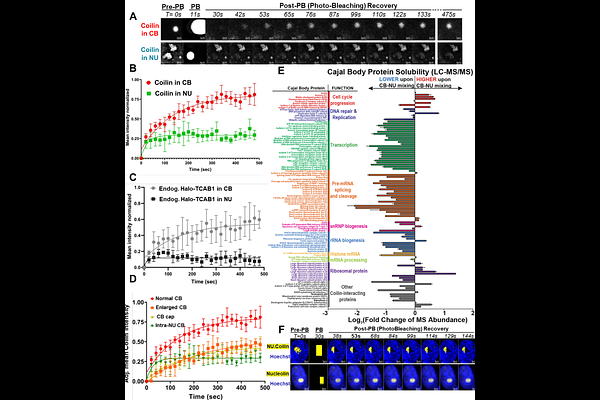
AbstractCellular processes are compartmentalized within immiscible heterotypic condensates, yet the functional consequences of losing their physical segregation remain unclear. Here, we show that genetic inactivation of the RNA chaperone SMN forces the aberrant intermixing of the two most prominent nuclear condensates: nucleolus and Cajal Body (CB). Upon SMN depletion, CB components invade the nucleolus and undergo reduced mobility and solubility consistent with a liquid-to-gel-like hardening transition. The CB-scaffold coilin aberrantly enriches at the nucleolar FC/DFC boundary and occupies rDNA chromatin, thereby locally suppressing rRNA production. Concurrently, this sequestration globally impairs coilin targeting to snRNA/snoRNA loci and limits telomerase access to telomeres, reducing telomeric synthesis. Crucially, genetic coilin depletion alone alleviates this mistargeting and rescues these functional impairments across condensates. Our findings reveal an inter-condensate rheostat model in which the loss of CB-nucleolar immiscibility is directly sensed, communicated, and executed by CB remnants, thereby proportionally coupling the functional outputs of otherwise distinct RNPs essential for splicing, translation, and genomic integrity.