Characterization of ovine follicular fluid and granulosa cell-derived extracellular vesicles and their miRNA cargo following in vitro exposure to bisphenols A and S.

Characterization of ovine follicular fluid and granulosa cell-derived extracellular vesicles and their miRNA cargo following in vitro exposure to bisphenols A and S.
Desmarchais, A.; Uzbekova, S.; Maillard, V.; Papillier, P.; Douet, C.; Duret, T.; Uzbekov, R.; Piegu, B.; Lefort, G.; Teixido, N.; Carvalho, A.; Roger, S.; elis, S.
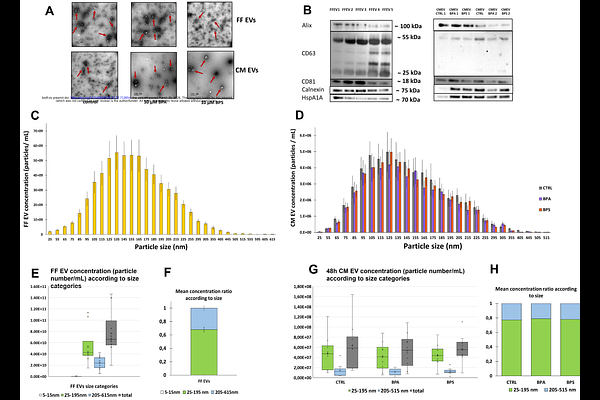
AbstractBisphenol A (BPA) and Bisphenol S (BPS) exposure disrupt ovarian function and granulosa cell (GC) steroidogenesis. Extracellular vesicles (EVs) and their miRNA cargo, as mediators of cellular response to environmental stimuli, might be involved in fertility and folliculogenesis. This study explored modulation of microRNA expression after 48h BPA or BPS exposure (10 M) in ovine primary GC and EVs from corresponding conditioned medium (CM EVs). Small RNA sequencing of control (0h) and 48h treated GC, CM EVs as well as follicular fluid EVs allowed identification of 533 ovine miRNAs, including 129 new sequences. BPA did not alter miRNA expression in GC, while BPS decreased cellular oar-24b miR. In contrast, BPA modified expression of 4 miRNAs in CM-EVs, including 3 new sequences, and two miRNAs were modified by BPS. Both compounds reduced expression of sequence homologous to miR-1306. Further studies are required to decipher their roles in bisphenol toxicity in GC.