Direct pathway enrichment prediction from histopathological whole slide images and comparison with gene expression mediated models

Direct pathway enrichment prediction from histopathological whole slide images and comparison with gene expression mediated models
Jabin, A.; Ahmad, S.
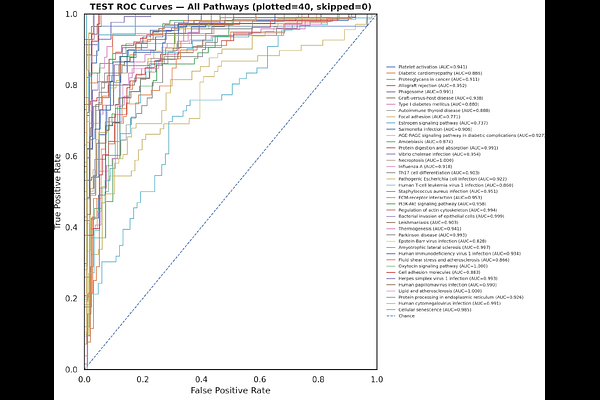
AbstractMolecular profiling of tumours via RNA sequencing (RNA-seq) enables clinically actionable stratification but remains costly, tissue-intensive, and time-consuming. Recent advances in computational pathology suggest that routine H&E whole-slide images (WSIs) can be utilized to estimate transcriptomic states of cancer cells. Given the WSI-derived predictions of transcriptional signatures are noisy, their use for accurate biological interpretation faces challenges. On the other hand pathway enrichment analysis has been routinely used in describing biologically meaningful cellular states from noisy gene expression data and some studies have evaluated the ability of WSI-predicted gene expression profiles to reconstruct enriched pathways in experiments where the two data modalities were concurrently available. However, it remains unclear if a predictive model that is designed to predict enriched pathways directly from WSI samples would be better than the current approaches to do so by first predicting gene expressions. Here, we develop and evaluate these two complementary approaches for predicting pathway enrichment profiles from WSIs in TCGA Breast Invasive Carcinoma (TCGA-BRCA) by training parallel models which predict pathway enrichment directly from image features and those which rely on predicted gene expression profiles, which is the current state-of-the-art. Our results suggest that under controlled experiments direct prediction of a selected pool of enriched pathways outperforms the models trained on predicting gene expression and then inferring enrichments on predicted gene expression values. These findings will be helpful in prioritizing the goals of predictive modeling of WSI images and improving diagnostic outcomes of cancer patients.